For basement mold remediation in Vista, CA, don’t approve a removal-only scope. Ask the independent pro to document the moisture source, affected boundaries, containment, removal, cleaning, and repair handoff before you sign. That written scope gives you concrete proposals to compare.

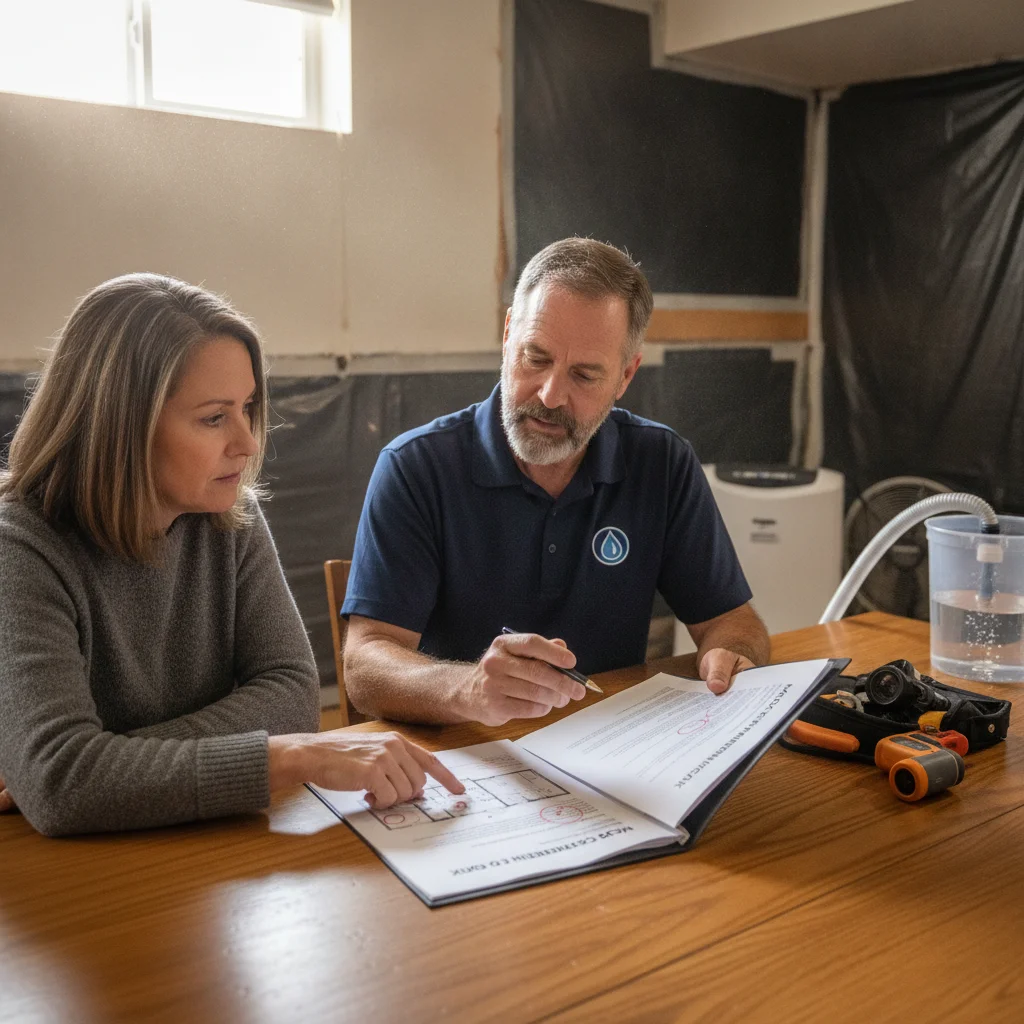
A Vista homeowner reviewing a written basement mold remediation scope with an independent local professional

Confirm the moisture source before remediation

Make moisture-source confirmation the first item in the proposed scope. Ask the pro to identify the suspected source and explain the observations behind that conclusion. A label such as “basement dampness” doesn’t give you enough detail for comparing proposals.

The source section should record:

  • The exact location where moisture was observed
  • The materials or fixtures inspected
  • Any readings taken and where they were taken
  • Areas that weren’t accessible during the assessment
  • The person responsible for correcting the source
  • Work that must happen before remediation begins

Ask whether the suspected source has been corrected. If it hasn’t, request a separate plan for that work. The remediation proposal should also explain whether the same contractor will address it or whether another trade must be involved.

Don’t let a proposed source become an undocumented conclusion. Request dated photographs, marked locations, and plain descriptions. If one pro attributes moisture to plumbing and another points elsewhere, ask each to show the basis for that opinion. The goal is a scope tied to your Vista property, not a generic mold checklist.

No Vista-specific moisture rule or remediation requirement is confirmed in the approved claims ledger. Before approving related repair work, ask the City of Vista whether the planned work requires local review or authorization. Describe the actual materials and systems involved rather than asking about “mold work” generally.

Our mold remediation referral service can match you with a licensed, independent local pro. Restore Pro SD doesn’t inspect, remediate, or repair the property itself.

Map mold and water beyond the visible basement area

A useful assessment turns the basement into a labeled map. Ask the pro to mark every inspected wall, floor, ceiling, opening, cabinet, stair area, and adjoining space. The map should distinguish visible conditions from areas assessed by other methods.

For each location, request a clear status. Useful labels include visible growth, staining, recorded moisture, no visible concern, and not inspected. Those descriptions keep a photograph or measurement from being applied to the entire basement without explanation.

Ask how the proposed boundary relates to adjacent rooms and materials. A basement wall may connect to a stair enclosure, storage area, utility space, or finished room. Your scope should identify which side of each boundary was inspected. It should also state where access was limited by finishes, stored belongings, built-ins, or fixed equipment.

Photographs should match the diagram. Request labels that identify the room, surface, direction, and date. Close-up images show surface detail, while wider images establish location. Keep both when they’re provided.

Don’t assume every dark mark belongs inside the remediation boundary. Likewise, don’t assume an unmarked area was assessed. Ask the pro to separate observed conditions from suspected conditions and proposed exploratory work.

Vista homeowners should insist on property-specific documentation. The approved claims ledger contains no verified statement about Vista basement construction, neighborhood soil, drainage, or housing stock. Those details must come from the property assessment or a verified local authority, not a citywide assumption.

Compare containment, removal, and cleaning boundaries

Break each proposal into separate work boundaries. At minimum, request distinct sections for containment, material removal, cleaning, moisture-related work, contents handling, and the repair handoff. A single line reading “basement mold cleanup” hides too many decisions.

For containment, ask the pro to mark the proposed boundary on the basement diagram. The scope should identify covered openings, access points, adjoining areas, and any equipment included. It should also explain when the containment setup will be changed or removed.

For removal, request a material-by-material list. Drywall, trim, flooring, insulation, cabinets, and stored contents shouldn’t be grouped under one vague allowance. The proposal should identify the intended removal boundary and explain how changes will be documented if the observed conditions differ after access begins.

For cleaning, ask which surfaces are included, which methods are proposed, and which products may be applied. Product names and instructions should appear in writing when available. If the scope includes testing or post-work review, identify who performs it and what written result you receive.

If a contractor cites IICRC S520, ask what specific scope decisions that reference supports. No IICRC S520 requirement for Vista is confirmed in the approved claims ledger, so don’t treat the label alone as proof of a complete scope.

Our overview of mold remediation services explains the matching process. Your contract, payment terms, and work scope remain directly between you and the independent professional.

An independent remediation professional hanging containment sheeting across a basement doorway before removal begins

Verify the independent pro through official sources

Restore Pro SD is a referral service. We match Vista homeowners with licensed, independent local water damage professionals. We don’t hold a trade license, employ restoration crews, own equipment, perform remediation, set prices, or provide warranties.

Before signing, compare the contractor’s exact business name and license number with the official CSLB license check. Use the information shown on the proposed contract. Similar company names aren’t enough for a reliable comparison.

Ask who will sign the contract and who will perform each part of the proposed work. If another business or specialty trade will participate, request its name in writing. Check any license information attached to that business separately.

Insurance, bonding, and certification claims also deserve direct verification. Ask the contractor to identify the issuer and provide current documentation. Don’t attribute those credentials to Restore Pro SD. The referral service doesn’t hold them.

Permit requirements for a particular Vista repair couldn’t be confirmed from the approved claims ledger. Contact the City of Vista before approving associated plumbing, electrical, structural, or finish repairs. Explain the exact proposed work and ask which office can confirm current requirements.

For general background before interviewing a contractor, review the EPA mold and moisture guidance. Use it to prepare questions, not as a substitute for a written property assessment or current local direction.

What Vista homeowners should document before repairs

Build one property file before removal or reconstruction changes the basement. Start with dated photographs and videos showing the affected rooms, nearby spaces, contents, and visible conditions. Keep the original files when possible.

Save every version of the scope. Mark the date received, contractor name, and assumptions listed in each version. If the work boundary changes, request a written change order that identifies the added or removed materials. Don’t rely only on a phone conversation.

Your file can include:

  • The moisture-source assessment
  • Basement diagrams and inspection notes
  • Photographs linked to labeled locations
  • Proposed containment and removal boundaries
  • Product names and written instructions
  • Contractor and license information
  • Contracts, invoices, and written change orders
  • Any readings, logs, or completion notes provided
  • Insurance correspondence, if a claim exists
  • City guidance about planned repair work

After remediation, request documentation that distinguishes completed work from remaining repairs. Final photographs should use the same location labels as the initial set. If measurements or testing were part of the contract, keep the written results and the name of the party who produced them.

Don’t describe the basement as cleared or repaired unless the supporting document states what was evaluated and by whom. Keep remediation completion separate from reconstruction completion.

For more selection questions, use our guide to choosing a mold remediation contractor. It helps you review the independent pro without confusing that contractor with Restore Pro SD.

When to call us

When a Vista basement has continuing moisture, suspected mold, or unclear work boundaries, ask a licensed water damage restoration pro to assess the scope. Restore Pro SD can match you with an independent professional, but we don’t perform or warrant the work. Call us at (858) 400-4586. The line plays a recording-consent notice, then takes a recorded and transcribed message. It isn’t answered live and doesn’t forward.