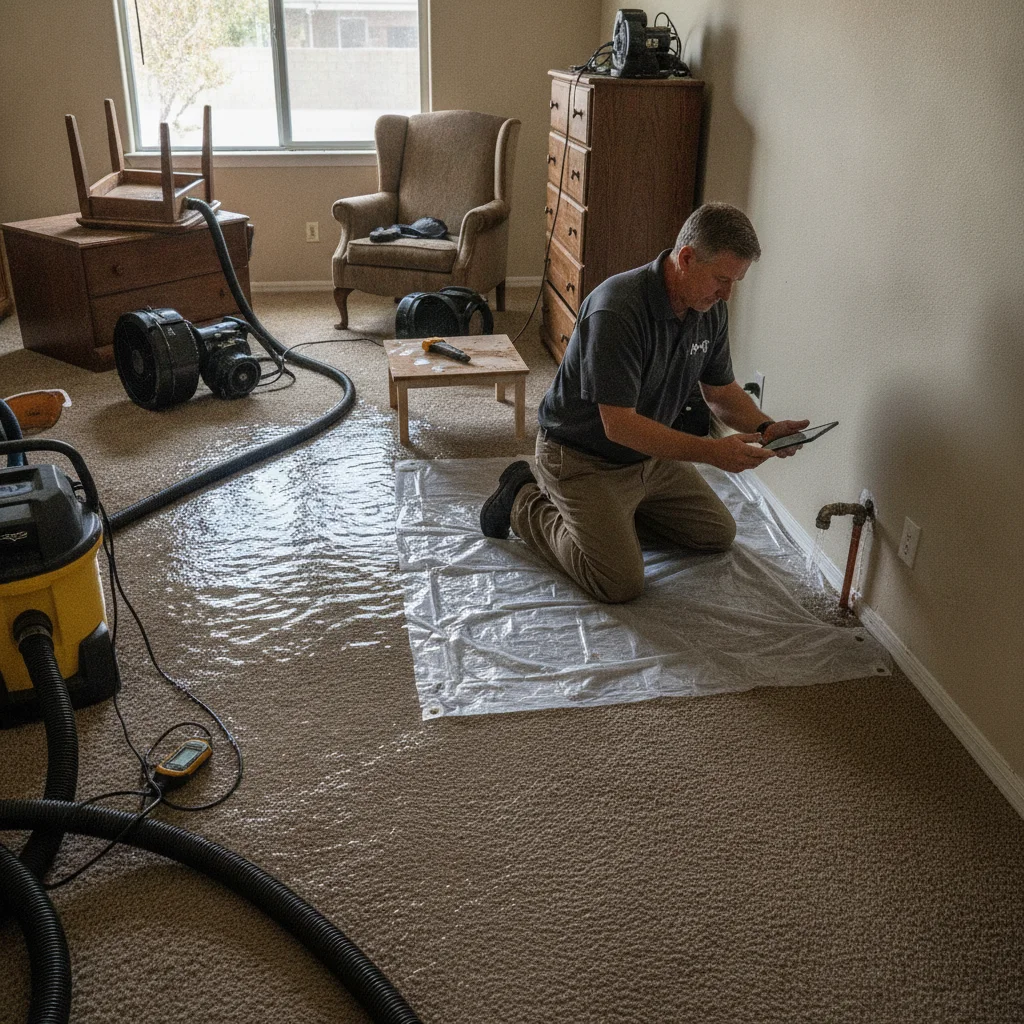
Water spreading across a rental’s carpet creates two immediate decisions: what needs professional attention, and who can grant access. For carpet water extraction in El Cajon, document the room first, then request a written scope from the independent restoration pro who inspects it.
Stop the water source and document the room
Start by identifying where the water appears to be coming from. If you can stop the source without entering a hazardous area, do so. If the source isn’t accessible, tell the property manager exactly what you observed.
Take wide photos showing the entire room before moving belongings. Then capture closer views of the wet carpet, nearby furniture, baseboards, doorways, and the suspected source. Add a short video that shows the path the water followed.
Record when you first noticed the problem. Note any sounds, odors, stains, or changes underfoot without guessing what caused them. If more than one room is affected, document each room separately. Show transitions where carpet meets tile, vinyl, laminate, or another floor covering.
Don’t discard carpet, padding, or damaged belongings before discussing documentation needs with the relevant parties. Instead, ask what should be photographed and who needs copies. Keep your original files along with messages, work scopes, and receipts.
Send the property manager a brief written account. Stick to observable details, such as the room, source location, and visible extent. If the leak involves another unit or shared area, identify that location without assigning blame.
A specific payment or notification rule for this situation couldn’t be confirmed from the approved sources for this page. Check your lease, ask the property manager, and contact your insurer or a qualified local adviser about your circumstances.
Identify what soaked the carpet and padding
The independent restoration pro will need a clear description of the water source. Tell them whether you saw water coming from a supply line, appliance, fixture, drain, ceiling, doorway, or an unknown location. Don’t label the water based only on its appearance or smell.
Share what happened before the carpet became wet. A leaking appliance, overflowing fixture, plumbing problem, and outside water entry may lead to different cleanup discussions. If you don’t know the source, say that plainly. An accurate unknown is more useful than a confident guess.
Ask the pro to explain how the source affects the proposed scope. The written scope should identify the rooms and materials being addressed. It should also state whether the plan involves surface extraction, lifting carpet edges, handling padding, removing material, or drying nearby areas.
Padding deserves its own line in that conversation. Ask whether it was inspected and how the pro reached the recommendation. If removal is proposed, request a clear description of what will be removed. If the carpet may remain, ask what observations support that option.
Furniture and personal property can complicate wet carpet cleanup in an El Cajon rental. Clarify who will move each item and where it can be placed. Photograph the room again after anything is moved.
Our guide to whether water-damaged carpet can be saved explains the questions that shape that decision. The final recommendation should come from the independent pro who inspects the carpet, padding, and surrounding materials.
Check the subfloor and nearby walls
A carpet extraction scope shouldn’t leave the supporting surfaces unexplained. Ask the independent pro whether the subfloor, wall edges, baseboards, transitions, closets, and adjoining rooms were checked. Request written findings for each area included in the inspection.
Ask how the pro evaluated conditions beneath the carpet. If readings or other observations were taken, request a copy. A simple room sketch can help show where conditions were checked and which sections are included in the work.
Pay attention to the room’s edges. Water may be visible near a doorway but less obvious along a wall or beneath furniture. Don’t assume the affected area ends where the surface looks different. Ask the pro to mark the boundaries used for the scope.
The subfloor should be addressed by name. Request separate findings for the carpet, padding, and material underneath. If the recommendation changes after the carpet is lifted, ask for an updated written scope before additional work continues.
Do the same for nearby walls. Ask whether baseboards or lower wall areas need further assessment. If the pro recommends opening or removing material, request the reason, location, and extent in writing.
For general background, the EPA’s mold and moisture guidance offers information you can review while discussing the project. Your El Cajon rental still needs an assessment tied to its actual materials and water source.
Coordinate access with the property manager
Rental carpet water damage often involves several contacts. The tenant may be available at the unit, while a property manager or owner handles work authorization. An insurer may request different records. Confirm each person’s role instead of assuming it.
Ask the property manager who can authorize inspection, extraction, material removal, and follow-up access. Get the name and contact information in writing. If the manager uses a portal or maintenance system, save the confirmation or ticket.
Make one access plan for the El Cajon unit. It should identify who will open the property, which rooms can be entered, and whether pets or locked areas require coordination. Tell the independent pro about parking, stairs, elevators, gates, and unit-entry instructions without publishing or sharing unnecessary access codes.
Keep one timeline of messages and visits. Record when you reported the water, when access was offered, and when a proposed scope arrived. This helps everyone work from the same sequence without turning uncertain memories into claims.
Don’t state that a tenant, landlord, property manager, or insurer must pay for a particular item unless a qualified adviser confirms it for your situation. The approved sources for this page don’t establish that responsibility. Review your lease and policy, then ask the relevant parties for written decisions.
Our article about rental water damage and tenant-landlord coordination in California provides more questions to raise. It doesn’t replace advice about your lease or claim.
Restore Pro SD matches customers with licensed, independent local water damage professionals. You contract with and pay the selected professional directly. You can also confirm a contractor’s status through the CSLB license check.
Compare extraction, removal, and drying scopes
Compare written scopes by what each one includes. A short label such as “carpet extraction” doesn’t explain the full plan. Ask every pro to identify the affected rooms, materials, proposed actions, and exclusions.
Start with the carpet. Does the scope cover the entire room or only a marked area? Does it address edges, closets, transitions, and areas beneath movable furniture? Ask how the planned work connects to the observed water path.
Next, look for separate treatment of the padding and subfloor. The scope should make each recommendation easy to find. If one option includes removal and another doesn’t, ask each pro to explain the difference based on the inspection.
Review the nearby wall section as well. Confirm whether baseboards, lower walls, door trim, and adjoining spaces are included or excluded. Don’t treat missing details as automatic approval. Request a revised scope when the document doesn’t answer a material question.
Ask how progress will be recorded. Find out what documentation you’ll receive and who will receive copies. Also confirm how the pro will communicate if new affected areas appear after work begins.
Price matters, but Restore Pro SD doesn’t set contractor prices. Request an itemized total from the independent pro and ask what circumstances could change it. Don’t assume two totals cover the same work when the listed materials and exclusions differ.
Our carpet water extraction service page explains how we connect customers with local professionals. The selected pro should provide the project scope, pricing, authorization terms, and any statements about their work directly.
When to call us
Call when an El Cajon rental has wet carpet, an unclear affected area, or a scope that needs professional assessment. Restore Pro SD is a referral service and performs no physical restoration work. Call us at (858) 400-4586. The line plays a recording-consent notice, then takes a recorded and transcribed message. It isn’t answered live and doesn’t forward.