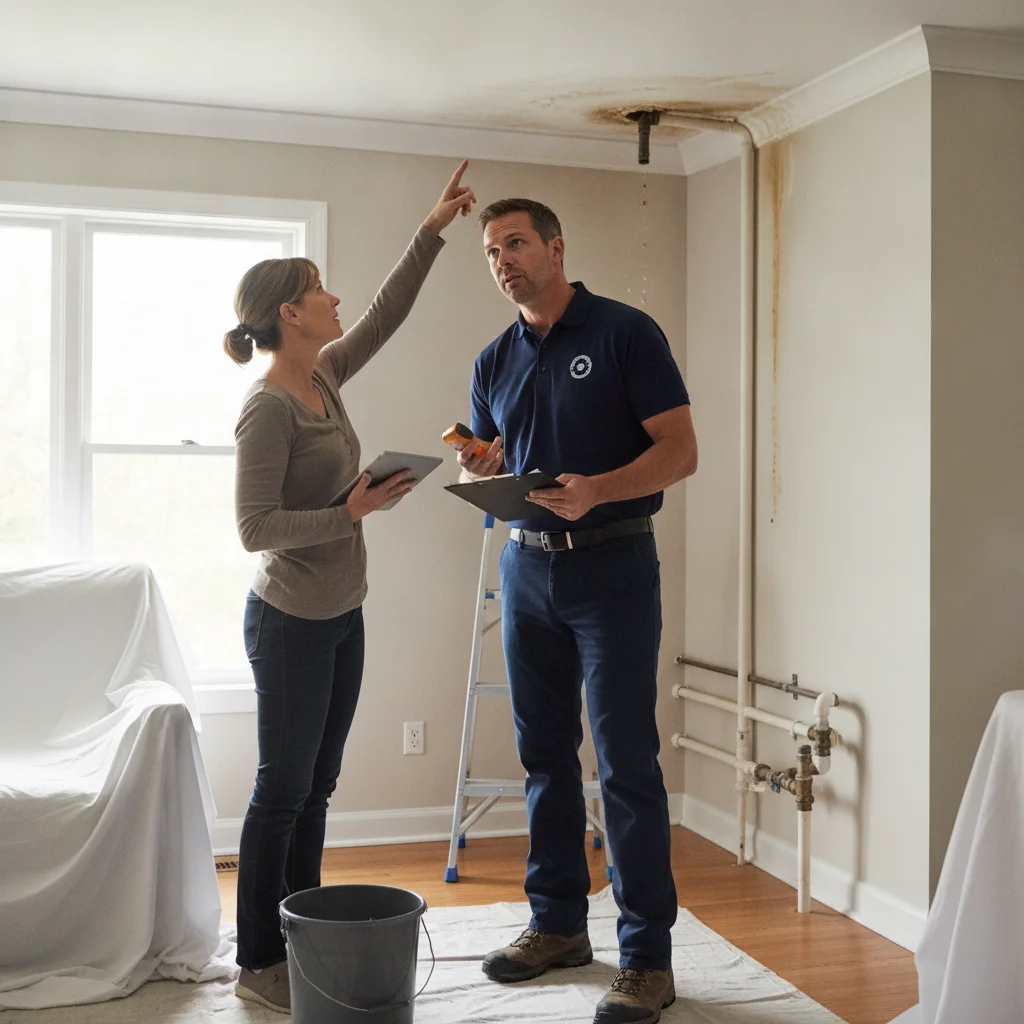
Choosing a ceiling water damage company starts with scope, not sales language. Look for an independent professional who will document the moisture problem, define their role, and identify work that needs another provider. Restore Pro SD matches San Diego County homeowners with licensed, independent local restoration pros.
Identify the source before ceiling repairs begin
A ceiling stain identifies a location, but it doesn’t confirm the source. Ask each candidate how the source will be investigated and who will handle it. Plumbing, roofing, appliance, restoration, and finish-repair work may have separate scopes.
Start with four written questions:
- What source does the professional suspect?
- Who will confirm that source?
- Is source correction included in the proposed scope?
- What work must another provider complete?
These questions matter because a ceiling project can include several distinct decisions. One professional may assess moisture and manage drying. Another may address the condition that allowed water to reach the ceiling. A separate provider may complete drywall, texture, or paint work.
Don’t treat a verbal guess as a final diagnosis. Ask the professional to distinguish observed conditions from suspected causes. The proposal should also explain what happens if the source differs from the first assessment.
Our guide to ceiling water stain causes and fixes can help you organize the first conversation. Use it to build questions, not to diagnose the property yourself.
For San Diego County homeowners, the useful comparison isn’t simply which company offers the longest task list. It’s which candidate clearly assigns responsibility. You should know who investigates, who documents, who performs restoration work, and who handles remaining repairs. That clarity makes competing scopes easier to compare.
Separate immediate safety checks from restoration
Before discussing appearance, ask who will evaluate immediate site concerns. A ceiling leak cleanup professional should explain what their assessment covers. They should also identify concerns that require a different qualified provider.
No single project-specific safety procedure can be confirmed through a general article. Conditions must be evaluated at the property. Ask the professional for direct guidance before entering, touching, opening, or testing the affected area.
Have each candidate address these points in writing:
- Whether the affected area should remain unused
- Whether ceiling material needs a separate assessment
- Whether nearby electrical components need qualified review
- Whether the water source changes the proposed cleanup
- Who makes each decision before routine restoration begins
These are coordination questions, not statements about legal trade boundaries. A restoration provider may recommend separate plumbing, roofing, electrical, or repair help. Ask who contacts those providers and whether their work appears in the same proposal.
Be careful with broad phrases such as “everything is included.” Request the actual tasks instead. The scope should state which professional performs each task and which items remain your responsibility.
Restore Pro SD is a referral service. We don’t inspect buildings or perform physical work. We match homeowners with licensed, independent local restoration pros. The professional must provide the property-specific assessment and safety direction.
Ask how hidden moisture will be assessed
A useful proposal explains how the professional will assess areas beyond the visible stain. Ask what locations they plan to examine, which methods they use, and how they record their findings. You don’t need technical language. You need a process you can follow.
Ask the candidate to describe:
- The initial assessment area
- The tools or methods used
- How findings will be recorded
- How the drying plan may change
- How completion will be evaluated
- What documentation you’ll receive
Avoid accepting “it looks dry” as the whole explanation. Ask what observations support that conclusion. If the professional uses readings, photographs, diagrams, or logs, request copies and an explanation of what they show.
No specific industry credential, protocol, or certification has been verified for any candidate through this page. If a professional cites one, ask for the exact name and issuing organization. Then verify it directly with that organization before relying on the claim.
Ceiling material also isn’t the only item worth discussing. Ask whether nearby wall surfaces, insulation, trim, flooring, or adjoining spaces fall within the proposed assessment. This doesn’t mean every item needs removal. It means the written scope should state what will and won’t be evaluated.
Our guide to deciding whether to repair or replace wet drywall can help you prepare material-specific questions. The final recommendation should still come from the professional who assesses the property.
Compare drying, removal, and repair boundaries
Two proposals may use similar headings while covering different work. Compare tasks, responsible parties, and exclusions. Don’t compare only the final price or a broad label such as “ceiling restoration.”
Ask each ceiling water damage company to separate the scope into clear phases:
- Source investigation and source correction
- Moisture assessment and documentation
- Water removal or drying work
- Ceiling material removal, if proposed
- Cleaning and debris handling
- Drywall or ceiling reconstruction
- Texture, primer, and paint
- Work assigned to another provider
These categories don’t define legal trade boundaries. They expose practical gaps. One proposal may end after drying. Another may include selected repairs. A third may depend on separate work before restoration can continue.
Ask why each removal task is proposed. The explanation should connect the task to observed conditions at your property. If one candidate proposes removing material and another proposes drying it in place, ask both to document their reasoning.
Also request a clear change process. The proposal should explain how the professional will communicate newly discovered conditions and seek your approval before adding work. Don’t assume an unlisted task is included.
Our ceiling water damage service page explains how Restore Pro SD can help you find independent local restoration help. The matched professional sets the scope and price. You contract with and pay that professional directly.
Restore Pro SD doesn’t set prices, perform restoration work, or provide warranties. Ask every provider to state any applicable terms in their own written agreement. If no warranty appears there, don’t assume one exists.
Verify each independent professional’s role
Verification starts after you’ve received the names involved. Ask for the full business name and any claimed license or credential details. Use the official CSLB license check and follow its current instructions.
Don’t rely only on a logo, vehicle, referral, or verbal statement. Confirm the information supplied by the professional against the official source. Save the result with your project notes and record when you checked it.
Next, map every role in the project. A simple written list can prevent confusion:
- Restore Pro SD provides the referral match.
- The independent professional assesses the property and proposes a scope.
- Other qualified providers may handle separately scoped work.
- You select the provider and approve the written agreement.
- You contract with and pay the chosen professional directly.
Ask who supervises each task and who answers questions about changes. If subcontractors or additional providers may participate, ask the primary contact to identify them before their work begins. Verify any credentials they claim through the appropriate official source.
A strong hiring decision doesn’t require every service under one company name. It requires clear ownership of each step. You should understand who addresses the source, who handles ceiling water damage restoration, who documents progress, and who completes finish repairs.
Restore Pro SD serves San Diego County as a referral service. It doesn’t employ restoration crews, own restoration equipment, perform physical work, or hold a trade license. Its role is matching homeowners with licensed, independent local water damage professionals.
When to call us
When ceiling damage may require moisture assessment, drying, removal, or restoration coordination, ask for a licensed Water Damage Restoration pro. Call us at (858) 400-4586. The line plays a recording-consent notice, then takes a recorded and transcribed message. It isn’t answered live and doesn’t forward.