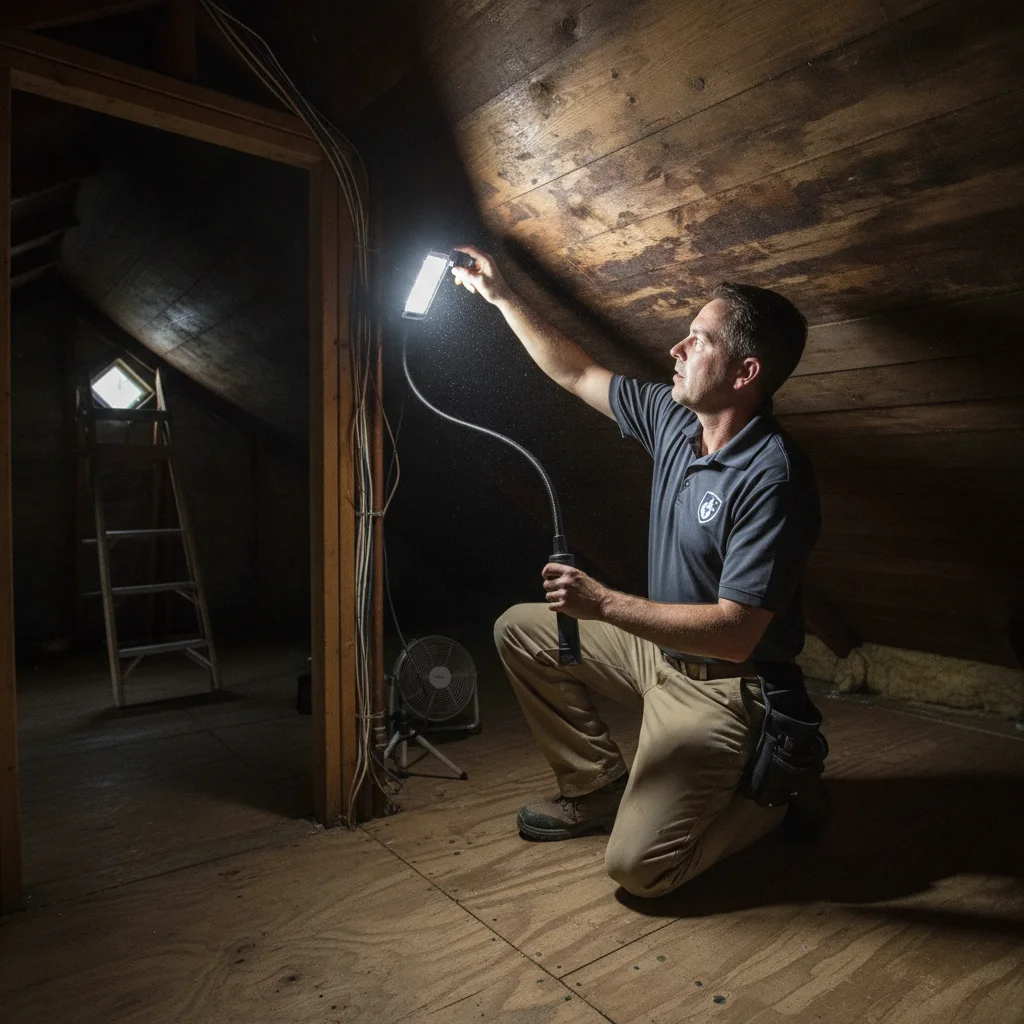
A repaired roof doesn’t answer what happened beneath it. For mold removal in Rancho Penasquitos, the next step is a documented inspection of the attic, insulation, framing, and ceiling cavity. The restoration scope should address affected materials before the ceiling is closed.
How a roof leak hides mold in an attic or ceiling cavity
Water entering through a roof may not fall straight down. It can follow sheathing, framing, fasteners, or nearby openings before reaching the ceiling. That means the visible stain may not show the full affected area.
An attic can also hide the problem from the occupied rooms. Insulation may cover the back of the ceiling. Framing can block a clear view from the access hatch. A small finished-room stain may sit below a wider area that needs inspection.
Don’t treat the roof patch as proof that the interior is ready. Keep the exterior repair and interior restoration as separate scopes. Our guide to roof leak water damage in San Diego explains how those two parts fit together.
No neighborhood-wide roof type or construction pattern for Rancho Penasquitos has been confirmed in the approved site records. The scope should come from the actual house, not assumptions about nearby homes. Ask the contractor to identify the roof assembly, attic access points, affected ceiling areas, and visible water path.
Take photos from safely accessible areas before materials move. Record where stains appeared and whether they changed. Don’t enter an unsafe attic or disturb suspected growth yourself. The EPA’s mold and moisture guidance provides general background for homeowners deciding what to do next.
What gets checked once the roof itself is repaired
Once the roof work is complete, the restoration pro should define the interior inspection area. That scope may include the underside of the roof deck, nearby framing, insulation, the back of the ceiling, and openings around vents or fixtures.
Ask for more than a visual opinion. The contractor should explain what areas were accessible, what was measured, and what couldn’t be seen. If access is limited, ask how that limitation affects the proposed work. A clear plan should connect each removal or cleaning step to an observed condition.
Useful questions include:
- Where does the suspected water path begin and end?
- Which surfaces show staining or suspected growth?
- What insulation or ceiling materials need closer evaluation?
- How will hidden sides of the assembly be checked?
- What records will show conditions before and after the work?
Old discoloration and current moisture aren’t the same finding. Ask the pro to label each observation instead of grouping every mark together. If testing is proposed, ask what decision the result would change. Testing without a defined purpose may not settle the removal scope.
Our mold remediation service connects San Diego County homeowners with licensed, independent local pros. Restore Pro SD is a referral service. We don’t inspect, remove materials, perform roof work, or set the contractor’s scope.
How insulation and framing are handled differently
Insulation and framing shouldn’t be treated as one material. Insulation is loose or fitted within the cavity. Framing is part of the fixed roof and ceiling assembly. The contractor should evaluate each separately and explain the proposed handling.
For insulation, ask which sections are affected and how those boundaries were chosen. The plan should state whether material will remain, be removed, or receive further evaluation. It should also explain how removed material will leave the attic without passing uncontained through living areas.
Framing requires a surface-by-surface decision. Ask the contractor to identify the sheathing, rafters, trusses, or other members included in the work area. The written scope should distinguish cleaning from removal and explain how the finished condition will be documented.
Ceiling drywall is another separate decision. A room-side stain doesn’t automatically describe the condition on the hidden side. Before approving replacement or closure, ask whether the back of the ceiling was inspected and photographed.
Don’t accept a coating or fresh paint as the only evidence that the underlying condition was addressed. Ask what preparation occurred first and what documentation supports it. Our overview of the professional mold remediation process can help you compare those steps with a contractor’s proposal.
Why containment matters in an attic job
The attic may feel separate from the home, but the work still needs a defined boundary. The access hatch, ceiling openings, tools, workers, and removed materials all create routes between the work area and occupied rooms.
Ask the contractor for a written containment plan before disturbance begins. It should identify the work area, access route, material-removal route, and controls used around openings. It should also state how the contractor will keep debris and work residue within the planned area.
A useful containment discussion covers practical details:
- How will the attic hatch and nearby surfaces be protected?
- Where will removed insulation or debris be packaged?
- What route will workers use through the home?
- How will tools and equipment leave the work area?
- What condition will the access route be left in?
Ask whether IICRC S520 guides the proposed mold work and whether IICRC S500 applies to any remaining water-damage work. Request the edition being referenced and the specific steps included in your scope. A certification and a state contractor license aren’t the same record. Confirm the contractor’s license directly through the CSLB license checker.
Containment details should match this attic and its access points. A generic paragraph in a proposal isn’t enough if it doesn’t describe your Rancho Penasquitos home.
What to ask before the ceiling is closed
Closing the ceiling removes easy access to the cavity. Use that moment as a documentation checkpoint, not just a construction milestone. Ask for the records you’ll need before insulation and drywall cover the work area.
The file should identify what was inspected, removed, cleaned, and left in place. Request clear photos of the exposed cavity. Ask that the photos show location and orientation, not only close views of individual surfaces.
Review these points with the contractor:
- Is the roof-repair scope complete?
- Which cavity areas were inspected?
- Which materials were removed or retained?
- What readings or observations support closure?
- Were previously hidden surfaces photographed?
- Who decides that the cavity is ready to close?
- Who handles insulation and ceiling replacement?
- Are any areas still excluded from the scope?
If another contractor will close the ceiling, make sure the handoff is written. The restoration pro and repair contractor should agree on what remains accessible and who owns each unfinished step. If the scope changed after opening the cavity, request an updated document before approving closure.
Ask about any contractor warranty in writing, if one is offered. Restore Pro SD doesn’t provide warranties because it doesn’t perform the work. The homeowner contracts with and pays the independent professional directly.
Keep the inspection notes, photos, work scope, and closure approval together. Those records help show what was evaluated without relying on memory after the ceiling is finished.
When to call us
Suspected attic growth, affected insulation, or a stained ceiling cavity calls for a licensed Water Damage Restoration pro. Restore Pro SD is a referral service, and the line records and transcribes your message after a consent notice. Call us at (858) 400-4586. The line plays a recording-consent notice, then takes a recorded and transcribed message. It isn’t answered live and doesn’t forward.