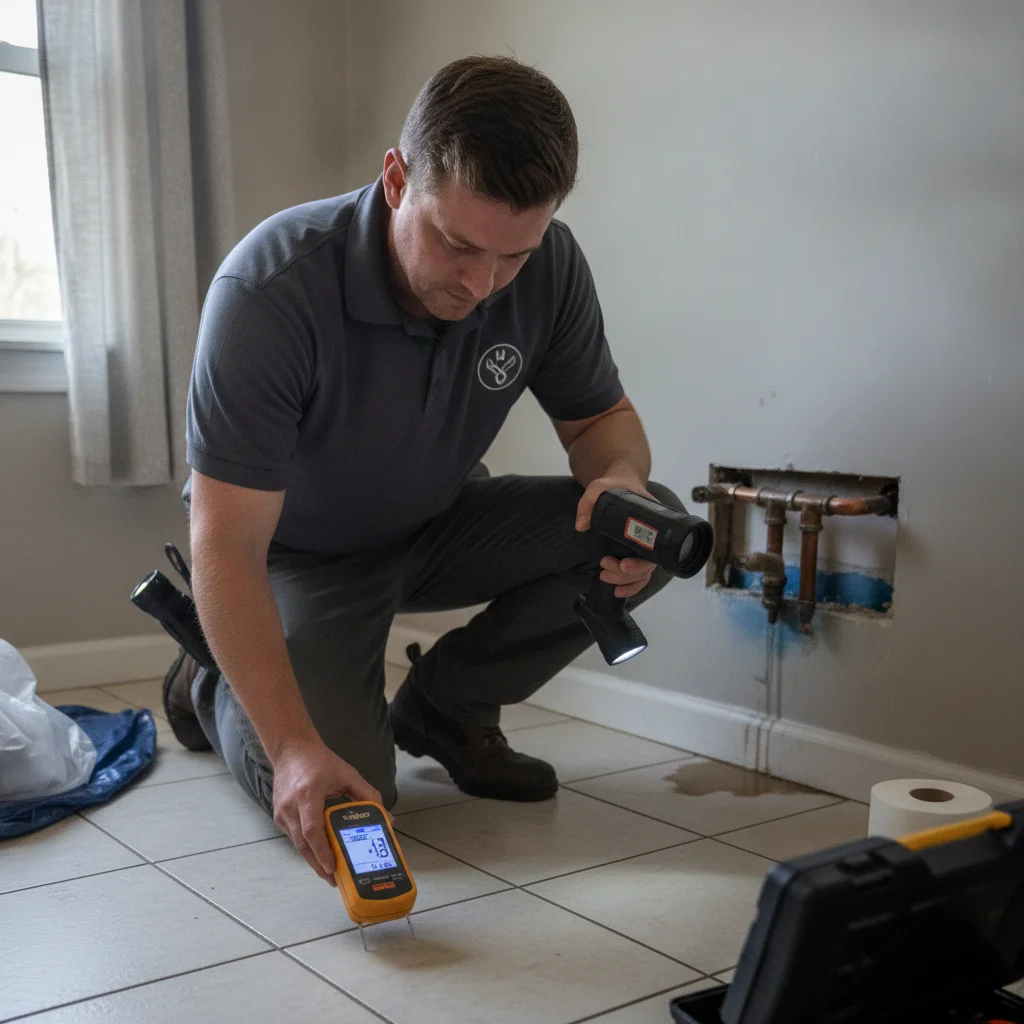
A dry tile surface doesn’t settle concerns about water under tile floor layers after a leak. An independent restoration pro can trace the affected area, document readings, and explain whether closer inspection is justified.

An independent restoration professional checking a tiled floor for hidden moisture after a residential leak

Why the tile surface can look dry first

The visible tile is only the starting point. Its appearance doesn’t confirm the condition of materials beneath or beside it. Wiping away surface water also doesn’t answer where the leak traveled.

A professional assessment should begin with the leak history. Tell the pro where you first noticed water. Explain when you found it and which rooms appeared affected. Share any photos taken before the surface was cleaned. These details help preserve evidence that may no longer be visible.

The source also matters to the investigation. A dishwasher leak creates a different starting point than water entering from an adjoining room. That doesn’t establish the final affected area. It simply gives the pro a place to begin tracing.

Watch for changes near the original leak. Mention loose grout, staining, unusual sounds underfoot, or water appearing at an edge. Those observations aren’t proof of hidden damage. They give the restoration pro more locations to examine.

Restore Pro SD couldn’t confirm a universal moisture target for tile assemblies from its approved claims ledger. We also couldn’t confirm one reading that proves every floor is dry. Ask the independent pro which materials were checked and what evidence supports the conclusion.

The goal isn’t to make a quick declaration from the tile’s appearance. It’s to separate what can be observed from what still needs investigation.

Trace water at edges and adjoining rooms

A pro may begin at the known source, then follow the visible boundaries. That often means examining wall edges, cabinet bases, thresholds, and flooring transitions. Each location helps build a picture of where further checks belong.

Tell the pro if water appeared outside the tiled room. A wet hallway edge or adjoining closet can change the assessment area. So can water found beneath a nearby cabinet or at a doorway.

This step matters in San Diego County homes with mixed floor finishes. A tiled kitchen may meet laminate, carpet, or wood at the next room. The pro should identify each material rather than treating the entire area as one surface.

When another finished floor is involved, the layer below may need separate attention. Our guide to wet subfloor water damage explains the questions homeowners can ask about that hidden layer.

A simple floor plan can make the findings easier to follow. The pro can mark the original source, visible water, checked locations, and uncertain boundaries. Ask for a plain explanation of why each boundary was chosen.

Don’t treat an unmarked room as automatically unaffected. Instead, ask whether it was checked and how. If access was limited by cabinets, fixed fixtures, or another finish, that limit should be documented.

Tracing establishes where the investigation has gone. It doesn’t guarantee that every concealed area has been exposed. A careful scope should distinguish confirmed findings from areas that remain uncertain.

How moisture mapping narrows the affected area

Moisture mapping organizes observations and readings by location. It isn’t a single test or a reason to buy a DIY meter. The useful part is the documented pattern created by a trained restoration pro.

The pro may label repeatable locations across the tiled area and nearby materials. Ask which instrument and setting produced each reading. Also ask which material the instrument was evaluating. A number without that context is difficult for a homeowner to assess.

A readable map should connect each result to a physical location. It might identify the leak source, room edges, adjoining finishes, and comparison areas. The pro can then explain where the pattern changes and where access remains limited.

Restore Pro SD couldn’t confirm published device-accuracy claims or numeric drying targets in its approved ledger. This article therefore doesn’t provide either. The independent pro should explain the basis for any target used in your project.

The map may change as new areas become accessible. If a cabinet toe kick is opened or a transition is exposed, the pro can add those findings. That update should show whether the proposed work area changed.

Ask for more than a verbal statement that moisture was found. Request a clear description of the checked locations, the materials involved, and the proposed next step. That record helps you compare the findings with the recommended scope.

Moisture mapping narrows the question from “Is something wet?” to “Which specific areas still need evaluation?” It should support the decision, not replace professional judgment.

An independent restoration professional pressing a moisture meter probe against grout lines on a tiled floor

Check the layers beneath the finished tile

The word “tile” describes the visible finish, not the whole floor assembly. Possible layers may include tile, setting material, an underlayment, and a subfloor or slab. The actual assembly must be identified at the property.

A pro may look for evidence at accessible transitions and existing openings. Building records or prior renovation documents may also help. Ask the pro to state which layers are known and which remain assumptions.

That distinction keeps the recommendation specific. A reading taken near the surface shouldn’t be described as a direct measurement of another layer unless the pro can support that statement. The written scope should name the material being assessed.

Homeowners sometimes expect one automatic answer: either all tile must come out, or none of it should. Restore Pro SD couldn’t confirm a universal salvage outcome for water trapped under tile. The correct recommendation depends on the evidence gathered for that floor.

If limited access prevents a clear finding, the pro should say so. Ask what additional inspection would answer the remaining question. You can also ask whether that step changes the proposed work or only confirms its boundary.

Any recommendation to remove finished material should include a reason. Ask which observation, reading, or access problem led to it. If the pro recommends leaving tile in place, ask how the concealed layer will be evaluated and monitored.

This isn’t about forcing a preferred outcome. It’s about understanding what lies beneath the finish and how the pro reached the proposed scope.

Use readings to define drying or removal

Readings become useful when they’re tied to a written plan. The plan should identify the affected area, the materials under review, and the next inspection point. It should also separate confirmed findings from unresolved areas.

If a pro recommends drying without removing the tile, ask how the concealed materials will be reached and monitored. Ask which locations will be checked again. The answers should refer to your floor, not a generic promise.

If removal is recommended, ask what it would expose. The scope should name the material being removed and the reason access is needed. It should also show whether the recommendation covers the full room or a defined area.

Don’t accept an unsupported drying time or guaranteed salvage result. Restore Pro SD’s approved ledger doesn’t confirm a standard duration, moisture target, or outcome for tile floors. The independent pro should document the project-specific basis for those decisions.

A proposal involving structural drying should be easy to follow. Ask what will be monitored, how progress will be recorded, and what finding ends or changes the plan. Those questions keep the scope connected to measured conditions.

Restore Pro SD serves San Diego County as a referral service. We match homeowners with licensed, independent local water damage professionals. We don’t perform restoration work, set prices, or provide warranties.

Before choosing a contractor, review the business information through the CSLB license check. Your work agreement and payment arrangement are made directly with the independent professional.

When to call us

If a leak is stopped but the area beneath tile remains unclear, ask a licensed Water Damage Restoration pro to assess it. Call us at (858) 400-4586. The line plays a recording-consent notice, then takes a recorded and transcribed message. It isn’t answered live and doesn’t forward.