TL;DR
- Find your main water shutoff before there is an emergency. Most homeowners do not know where theirs is.
- If the house valve is corroded shut, the meter shutoff at the curb is your backup.
- Cut power to wet rooms at the breaker if water is near outlets, switches, or panels.
- Call a restoration company first, then a plumber, then your insurance carrier — in that order.
- Open faucets at the lowest point in the house to drain pressure from the system.
A burst pipe loses about 200-400 gallons per hour at typical residential water pressure (50-80 PSI). Even a small split in a 1/2-inch supply line dumps tens of gallons in the first 10 minutes. How fast you stop the source decides most of the loss.
Here is the actual sequence to run if you are inside one of these emergencies right now.
Minute 0-2: Find the shutoff
Main shutoff at the house
Most San Diego homes have the main shutoff valve where the supply line enters the property. Common locations:
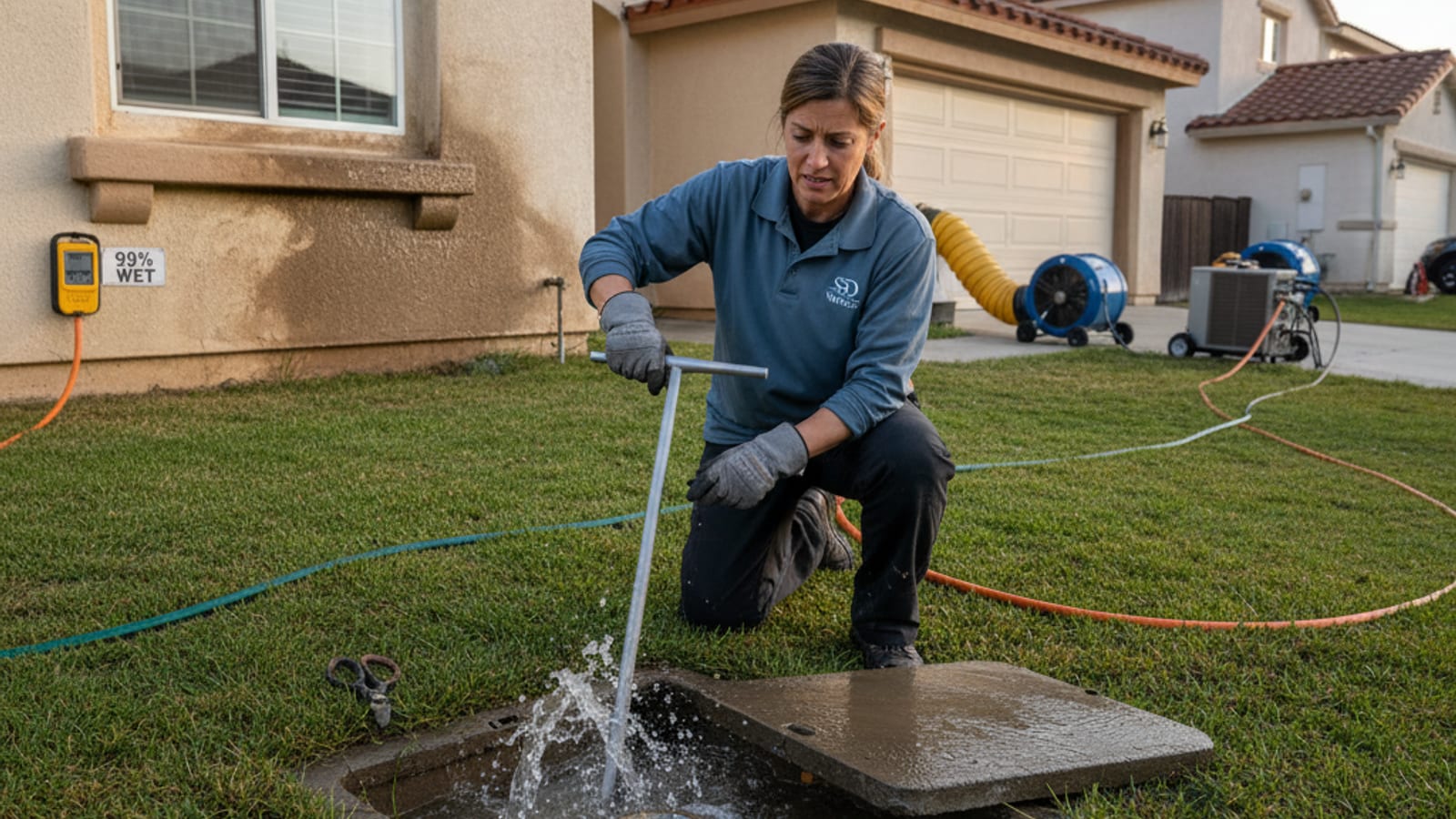
- Front yard near the meter — gate valve or ball valve in a small box
- Side of the house near the front — visible valve on the supply line
- Garage — valve where the line enters the home
- Crawlspace or basement — same, sometimes harder to access
If you have not located yours before, take five minutes after this loss is over and find it. Tag it. Take a photo so you can find it again at 2 a.m. in the dark.
House valve will not turn
This is common in older coastal homes — salt air corrodes shutoffs and they seize partially closed. Do not force it; you can break the valve and make it worse.
Backup: meter shutoff at the curb
Every San Diego property has a city water meter shutoff at the curb. Opening the meter box reveals a valve that requires a curb-key tool — most homeowners do not own one. If you have a friend or neighbor with one, borrow it. Otherwise, the city water department or a plumber can shut it off.
We carry curb keys on every truck for this reason. If you call us with an active leak and a seized house valve, we shut off at the meter on arrival.
Minute 2-5: Make it safer
Cut power to wet rooms
If standing water is anywhere near outlets, switches, light fixtures, or the breaker panel, kill the power at the breaker first. Do not walk through energized water.
For the breaker panel itself getting wet, call SDG&E for a service-side disconnect. This is the one situation where you call the utility before anything else.
Drain residual pressure
Even after the main is shut off, the supply lines are still pressurized. Open the faucets at the lowest point in the house — usually a basement or first-floor faucet. This drains the lines and stops the leak from continuing for the next few minutes while pressure bleeds off.
Open hot and cold both. The water heater will refill from the supply line as it drains; that is fine.
Minute 5-10: Document and call
Photograph everything
Wide shots first. Then close-ups of the burst location, the path the water took, and the damaged materials. Capture standing water with a measuring stick or a familiar object for scale.
Call the restoration company first
A restoration company’s job at this stage is to extract water fast and document the loss professionally for the insurance file. Calling restoration before plumber means we are on the way and the cause-of-loss documentation is professional from minute one.
Then call the plumber
Plumber’s job is the actual pipe repair. We are not licensed to do plumbing work — we want a real plumber on the repair side. Most homeowners have a plumber relationship; if you do not, your restoration company can refer one.
Then call your insurance carrier
File within 24 hours, sooner if the loss is significant. You will need a claim number to give the restoration company for direct billing.
What to do while you wait
Move what you can
Lift furniture off wet carpet — wood and metal contact with wet carpet causes permanent rust stains in 24 hours. Carry portable items (electronics, papers, rugs) to a dry part of the house.
Do not lift sagging ceiling drywall
A water-laden ceiling can collapse without warning. Move out from underneath. The bigger the sag, the more water is held up there.
Do not run regular vacuums on standing water
Electrocution risk. A wet/dry shop vac is fine if the area is not energized; a household vacuum is not.
What about hot water heater bursts?
A burst water heater dumps the tank capacity (40-80 gallons) plus whatever runs in from the supply line. Sequence is the same: shut off cold supply to the heater (valve on top of the tank), shut off main if you cannot reach the heater valve, shut off gas or electric to the heater, drain the tank to the outside via the drain valve at the bottom.
Many heater failures show evidence of corrosion before the burst — rust stains around the base, dripping at fittings, age over 10-12 years. Replace before they fail.
What about slab leaks?
Slab leaks are gradual, not sudden — but they often present with sudden discovery (warm spot on the floor, sound of running water with all fixtures off, high water bill).
Sequence:
- Shut off main to confirm the sound stops (verifies the leak is on your side of the meter)
- Call a leak detection company or plumber to locate the exact spot
- Plumber decides on repair approach (jackhammer through slab vs. reroute through walls/attic)
- We dry the slab, the bottom plates, and any wet cabinet bases after repair
Slab leaks often get partially denied as gradual damage on insurance claims. Fast discovery and clear cause-of-loss documentation matter most.
After the immediate emergency
Once the source is stopped and we are on site, the work is:
- Extraction — truck-mount and portable units pull standing water
- Demo — saturated drywall, cabinets, and flooring below the water line if the water category warrants it
- Drying — air movers and dehumidifiers bring materials to industry standard moisture content
- Antimicrobial — Cat 2 or Cat 3 water gets treated to prevent microbial growth
- Documentation — daily moisture readings logged for the insurance file
- Rebuild coordination — drywall, paint, flooring, cabinet replacement after we sign off on dry
Total timeline: 5-10 days for mitigation, additional weeks for rebuild depending on scope.
Bottom line
Burst pipes happen. Pre-loss preparation — knowing where the main shutoff is, knowing your insurance has water damage covered, having a restoration company in your contacts — turns a six-figure loss into a manageable insurance claim.
For an active emergency, call us at (858) 808-6055 — 24/7 across San Diego County. See also our burst pipe service page and our first-24-hours resource.