TL;DR

  • Shut off water at the main valve before anything else. Standing water doubles its damage every hour.
  • Photograph everything before cleanup — adjusters need to see the loss in its original state.
  • Cut power to wet rooms at the breaker if water is near outlets, switches, or panels.
  • Call a restoration company first, then your insurance carrier. The order matters.
  • Do not run regular vacuums on standing water and do not use bleach on mold.

The pipe burst. The dishwasher overflowed. The roof gave up during an atmospheric river. Whatever happened, water is now where it does not belong — and how you handle the next 24 hours decides the difference between a manageable insurance claim and a six-figure rebuild.

We have responded to thousands of San Diego County water losses. The homeowners who come out best are the ones who do five things in the first hour and avoid five mistakes in the first day.

The first hour: stop the source, document, decide

1. Shut off the water at the main valve

If the leak is internal — burst pipe, supply line, appliance — kill the water at the main shutoff. Most San Diego homes have it where the supply line enters the property, often near the front of the house or near the water meter. If you do not know where yours is, find it now and tag it. Future-you will be grateful.

If the house valve is corroded shut (common in older coastal homes), the meter shutoff at the curb is your backup. You will need a curb-key tool — most homeowners do not own one. We carry them on every truck.

2. Cut power if water is near electrical

Standing water near outlets, switches, light fixtures, or the breaker panel is an electrocution risk. Trip the breakers for the affected rooms before you walk through any wet area. If the water reached the panel itself, call SDG&E for a service disconnect. Do not be a hero on this one.

3. Photograph everything

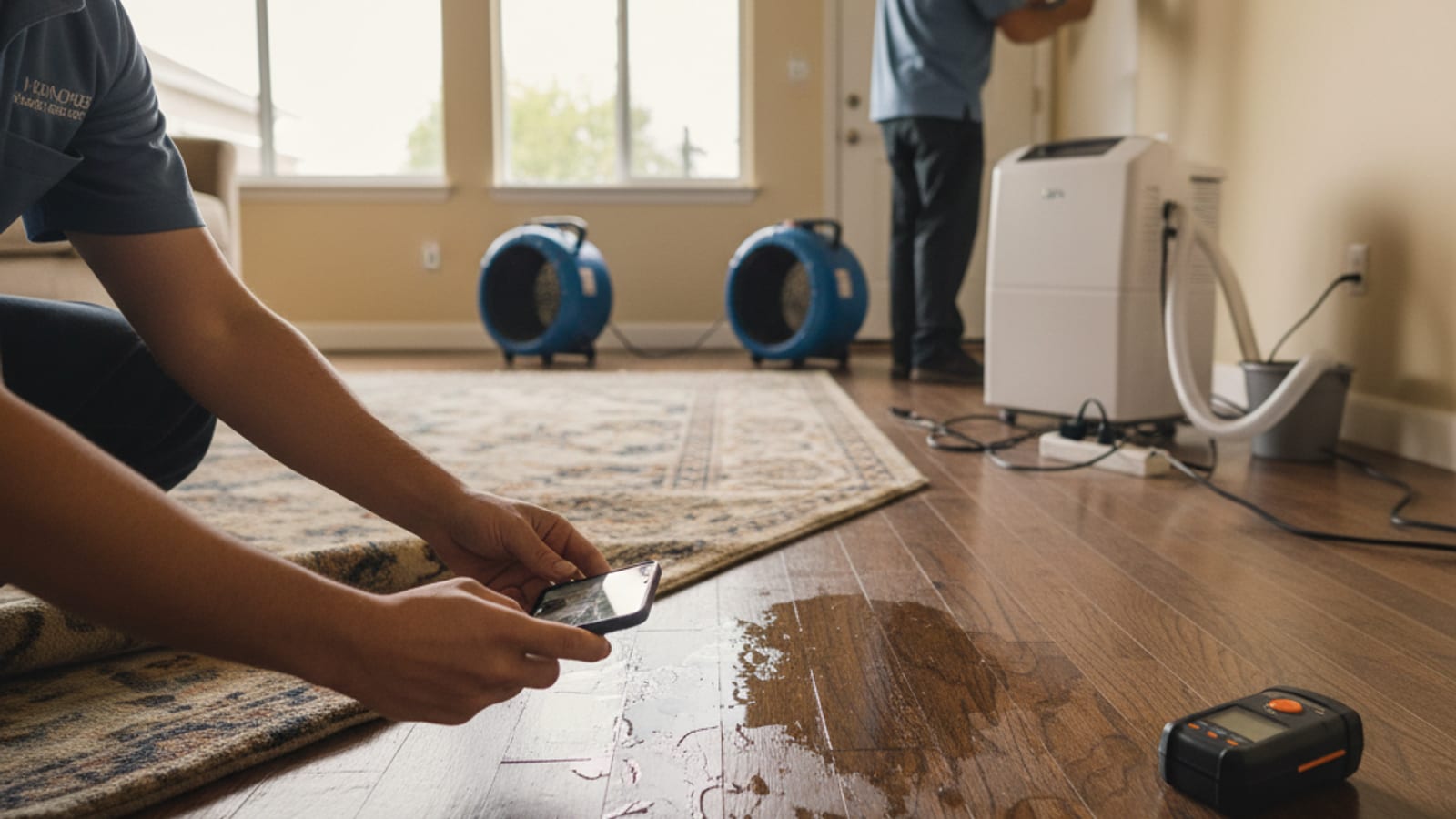
Take wide shots, close-ups, and progress photos. Capture the source of the water if you can identify it — a burst supply line, a failed appliance, a stain pattern from above. This documentation is what your insurance adjuster needs to approve a sudden-and-accidental claim quickly.

If the carpet is squishy under your shoes, that goes in the photos. If a ceiling has a stain ring or is sagging, that goes in the photos. If a wall has bubbled paint or a baseboard is dark with absorbed water, that goes in the photos.

4. Move what you can, leave what you cannot

Carry portable items — electronics, furniture you can lift, paper records, rugs, important documents — out of the wet area to a dry part of the house. Do not drag wet rugs across dry hardwood floors; you will spread the water damage to areas that were dry. Do not lift sagging ceiling drywall; it can collapse.

5. Call us first, then call insurance

This order matters. Restoration companies arriving first means accurate documentation from minute one — cause of loss, scope, conditions before mitigation. Adjusters love this. Calling insurance first often means a delay where standing water sits getting worse while you wait for an adjuster appointment.

The first day: extraction, drying, decisions

Once the source is stopped and we are on site, the work splits into three buckets.

Extraction

Truck-mount extractors and portable units pull standing water out of carpet, hard surfaces, and standing pools. The goal in this phase is to remove as much bulk water as possible in the first few hours. Carpet that gets extracted within 12 hours often saves; carpet that sits saturated for 48 hours often does not.

Demolition decisions

Some materials below the water line have to come out. The deciding factor is the water category:

  • Category 1 (clean water): supply-line failure, ice maker line, dishwasher discharge of clean water. Most porous materials can be dried in place.
  • Category 2 (gray water): washing machine overflow, dishwasher with food residue, sump pump backup. Carpet pad gets replaced; carpet often saves.
  • Category 3 (black water): sewage backup, flood water from outside, water that has been sitting more than 48 hours and grown microbial. Carpet, pad, drywall below the water line, and most porous materials all come out.

The IICRC S500 standard is the playbook here. We follow it because skipping demolition on contaminated water is the surest way to land mold remediation on top of water damage two weeks later.

Drying

Air movers move saturated air off the wet material. Dehumidifiers pull that moisture out of the air. The combination dries materials to industry standard within three to five days for most residential losses.

We use psychrometric calculations to size equipment to the affected area. Too few units and drying stalls. Too many wastes electricity. Daily moisture readings on every wet material show the curve dropping until materials hit dry standard, at which point equipment comes off.

What insurance covers (and what it does not)

Standard San Diego homeowners policies cover sudden-and-accidental water damage:

  • Burst pipes, supply line failures, appliance leaks
  • Sudden roof leaks during a covered storm event
  • Plumbing fixture failures (overflowed toilets, ruptured tank)

What is usually excluded:

  • Long-term seepage and gradual leaks (more than two weeks of slow water)
  • Flood water from outside the home (needs separate NFIP or private flood policy)
  • Sewer/drain backup without the specific endorsement (typically $40-$80/year add-on)
  • Mold remediation if not tied to a recent covered water loss

The single biggest reason claims get denied or reduced is documentation that did not get captured in the first 24 hours. Photos, cause-of-loss statements, and moisture readings from minute one are the difference.

What not to do

  • Do not run regular vacuums on standing water. Electrocution risk. Wet/dry shop vacs are fine if you have one and the area is not energized.
  • Do not use bleach on mold. It does not kill the spores in porous material and it adds moisture, which is exactly what mold needs.
  • Do not let furniture sit on wet carpet. Wood and metal contact with wet carpet causes permanent rust stains and warping in 24-48 hours.
  • Do not throw out anything before the adjuster has seen it or you have photos. Your insurance carrier may want to inspect actual materials.
  • Do not wait for “Monday morning” if the loss happens at night. Every hour of standing water is more damage. We answer the phone at 2 a.m. for this exact reason.

When to call us

Active water emergencies — call. Standing water more than ankle-deep, an active leak you cannot stop, sewage backup of any size, flood water from outside the home, water near electrical: all of these are emergency calls regardless of the hour.

Discovered staining or musty smell from a previous event can usually wait for next business day, but should not wait long. Mold has a 48-hour window from when the moisture started, and the clock is already running.

For more on the steps after the first day, see our first-24-hours guide and our insurance claim walkthrough. For an emergency, call us at (858) 808-6055 — 24/7 across San Diego County.