TL;DR

  • Mold needs three things: moisture, organic material, and time. Take away moisture in 48 hours and you starve the chain.
  • DIY extraction without drying is the #1 cause of mold calls two weeks later.
  • “Properly dried” means materials hit IICRC moisture-content targets, not “feels dry to the touch.”
  • Bleach does not kill mold in porous material — and adds moisture, which is exactly what mold needs.
  • If you can already see mold, you do not need a test to confirm it. Spend the money on remediation instead.

The most common mold call we get goes like this: “We had a leak about three weeks ago. We pulled up the wet carpet and let everything air dry. Now we are seeing dark spots on the baseboard and the room smells musty.” The homeowner did the obvious things — and missed the part that actually prevents mold.

This is the principle that matters: extraction is bulk water removal. Drying is moisture removal from materials and air. Skipping the drying phase is what grows mold.

What mold needs to grow

Three ingredients:

  1. Moisture — surface moisture for spores to land on, sustained moisture for them to multiply
  2. Organic material — drywall paper, wood, cellulose insulation, paper products, fabric, dust on hard surfaces
  3. Time — typically 24-48 hours from initial moisture for visible colonization

Take away any one of these and mold cannot grow. In a residential water loss, moisture is the only one you can actually remove fast. Drywall and framing are not going anywhere; time is going to keep ticking. Moisture is the variable.

The 48-hour rule

Industry consensus — IICRC, EPA, ACGIH — is that mold becomes likely after 48 hours of unmoved moisture on porous material. Aggressive drying within that window is what prevents it.

This does not mean “if it has been 49 hours, mold is definitely there.” It means the risk curve climbs sharply after 48 hours. The earlier and more aggressive the drying, the lower the risk.

In San Diego specifically:

  • Coastal homes in marine-layer humidity have a tighter window than inland — say 36 hours rather than 48
  • East County with low ambient RH has a more forgiving window
  • Interior cabinets, closets, and crawlspaces that get less air movement run higher risk than open living areas

What “properly dried” actually means

Here is where DIY usually fails. “I left the windows open and ran a fan for a couple of days” is not drying to standard. Materials can feel dry on the surface and still hold significant moisture in the cavity, the substrate, or the framing.

Industry-standard drying targets, set by the IICRC S500:

  • Drywall: under 16% moisture content (most pin meters read this directly)
  • Framing lumber: under 19% moisture content
  • Hardwood flooring: under 12-14% MC and within 2-4% of the dry baseline
  • Concrete slab: under 4% on a calcium chloride test, or matched to the dry baseline

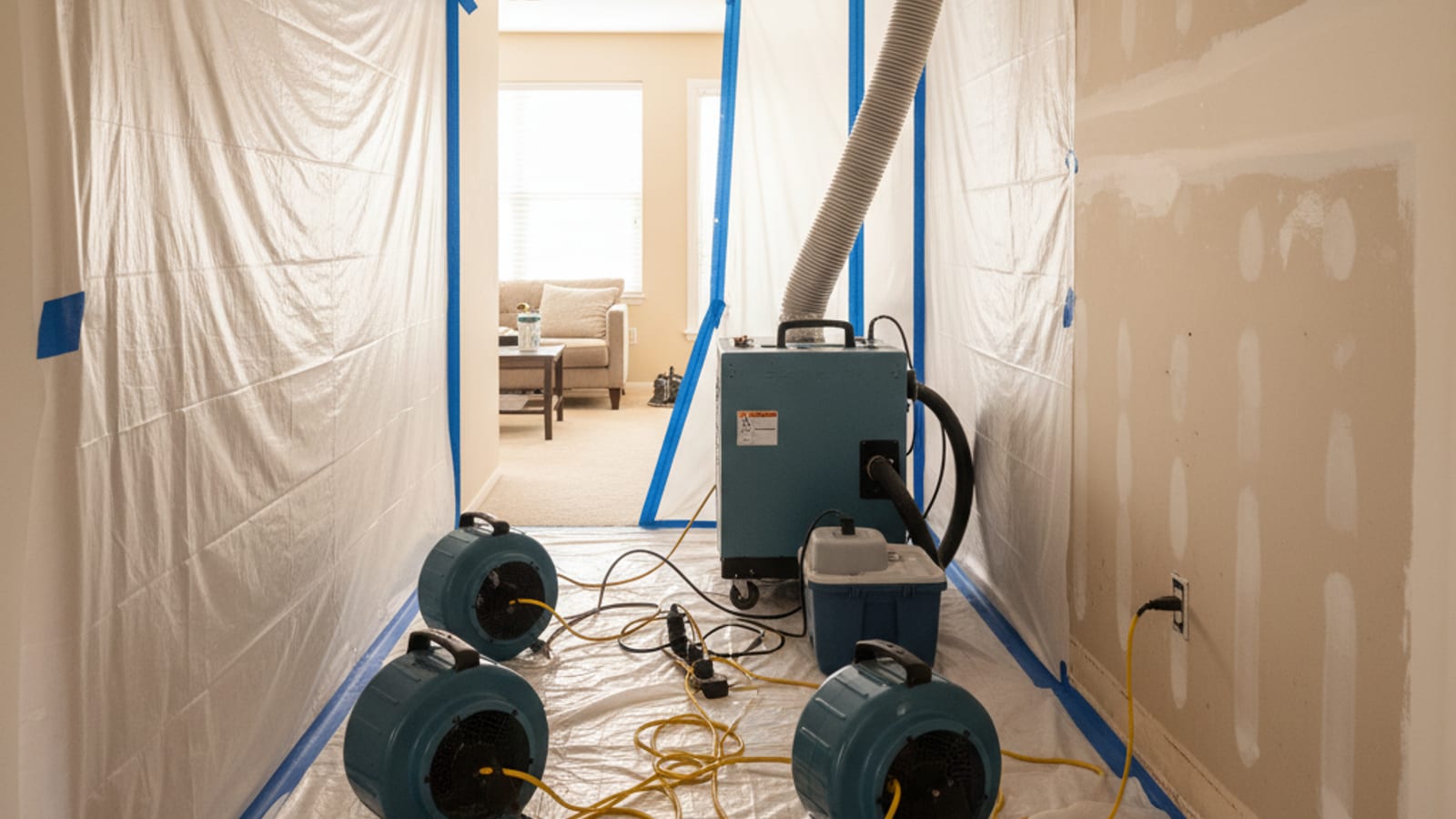
We hit those numbers using air movers (move saturated air off the wet material) and dehumidifiers (pull that moisture out of the air). The combination is sized by psychrometric calculation — too few units and drying stalls, too many wastes electricity. Daily moisture readings on every wet material show the curve dropping until the targets are hit.

A typical residential water loss dries to standard in three to five days with proper equipment. DIY attempts with consumer fans and a single dehumidifier often take 10-14 days, which puts the loss well past the 48-hour mold window.

What about the wet wall cavity?

This is the spot that catches most homeowners. The drywall surface dries fast — feels dry within a day or two. The wall cavity behind it (insulation, framing, the back side of the drywall) holds moisture for much longer.

If the wall stays sealed, the cavity can stay moist for weeks. Mold grows back there silently. Three weeks later, the wall starts to smell, the paint starts bubbling, and the homeowner calls.

This is why we either:

  • Open the wall with a flood cut (typically at 12 or 24 inches) when contamination or saturation height demands it
  • Cavity-dry it with InjectiDry hoses through small holes in the wall when the cavity can be saved

Either approach lets us actually verify the cavity is dry. Surface drying alone does not.

What about bleach? What about vinegar? What about the sprays at the hardware store?

  • Bleach on visible mold: kills surface spores on hard non-porous material. Does not penetrate porous material to kill the colony underneath. Adds moisture. Effective for mildew on tile grout; not effective for mold on drywall.
  • Vinegar: kills some species at high concentration. Less harsh than bleach. Same penetration limit on porous material.
  • Antimicrobial sprays: EPA-registered antimicrobial agents are part of the IICRC S520 mold protocol. They are effective applied to a properly cleaned surface — not as a one-step “spray and forget” solution.

The IICRC protocol is: physical removal of porous material with visible mold, HEPA vacuum the area, antimicrobial application on remaining surfaces, controlled drying. Bleach is not part of that protocol because it does not do what the protocol requires.

When you actually have mold (already)

The rest of this article is about prevention. If you already see colonies — black, brown, green, white spots on drywall, baseboards, ceilings, or behind cabinets — prevention is too late. You need remediation.

Remediation by the IICRC S520:

  1. Containment: zip walls, plastic sheeting, negative air to keep spores from spreading
  2. HEPA filtration: scrubbers running through the entire scope
  3. Removal: porous material with visible mold comes out (drywall, insulation, carpet pad)
  4. HEPA vacuuming: structural surfaces and remaining materials
  5. Antimicrobial application: per S520
  6. Clearance: independent industrial hygienist testing if needed

That is the protocol. Any company that sells you a “mold spray” treatment that skips the demo and the containment is selling you a paint-over, not a remediation.

Should I get a mold test?

Usually not before remediation. If you can see mold, the test confirms what your eyes already saw — money is better spent on the remediation work itself.

Tests make sense for:

  • Health documentation (someone has confirmed mold-related symptoms)
  • Real estate or legal matters
  • Clearance after remediation, performed by an independent industrial hygienist

We refer all testing to independent IHs so there is no conflict of interest with our remediation scope.

Bottom line

The 48-hour rule is the principle. Aggressive drying within the window prevents most water losses from becoming mold remediation jobs. DIY extraction without drying is the most common reason homeowners call us a second time.

If you are inside the window — call. If you are past it — call. We handle both, and we do the math on whether your situation calls for prevention drying or full remediation.

(858) 808-6055, 24/7 across San Diego County. See also our mold remediation service page and the structural drying explanation.