TL;DR

  • Cat 1 (clean water) under 48 hours: most carpet saves with extraction and a fresh pad.
  • Cat 2 (gray water) under 48 hours: carpet often saves, pad always replaces.
  • Cat 3 (sewage, flood, water sitting more than 48 hours): carpet, pad, and substrate all come out.
  • The pad is essentially a sponge — it gets replaced on Cat 2 and Cat 3 jobs by default.
  • Decision is based on the IICRC S500 standard, not what is profitable for the contractor.

“Can my carpet be saved?” is one of the first questions homeowners ask after a water loss. The honest answer depends on three variables: the water category, how long the carpet sat wet, and the carpet quality. Here is the actual decision tree.

The water category decides most of it

Category 1 — clean water

  • Source: supply line break, ice maker line, dishwasher discharge of clean water
  • Carpet outcome (under 48 hours): usually saves
  • Pad outcome (under 48 hours): often saves on light losses, replaces on heavier saturation
  • Process: extraction, pad-on or pad-out drying, antimicrobial treatment

Category 2 — gray water

  • Source: washing machine overflow, dishwasher with food residue, sump pump backup
  • Carpet outcome (under 48 hours): often saves with full sanitization
  • Pad outcome: always replaces
  • Process: extraction, pad removal, carpet float-drying with antimicrobial

Category 3 — black water

  • Source: sewage backup, flood from outside, water sitting more than 48 hours
  • Carpet outcome: does not save
  • Pad outcome: does not save
  • Substrate outcome: subfloor cleaned and sanitized in place if dimensional lumber; replaced if particleboard or saturated for too long

The IICRC S500 standard is firm on Cat 3 — anything porous below the contamination line comes out, period. Saving Cat 3 carpet is not done because the pathogens cannot be reliably removed from the carpet fibers.

How long it sat wet matters a lot

Within 24 hours, even Cat 2 carpet often saves. Between 24-48 hours, the decision tightens — Cat 1 still saves, Cat 2 borderline. Past 48 hours, even Cat 1 starts trending toward replacement because microbial growth begins.

In San Diego specifically:

  • Coastal homes in marine-layer humidity have a tighter window — 36 hours is more realistic than 48
  • Inland homes with low ambient RH have a more forgiving window
  • Closed rooms without air circulation degrade faster than open spaces

If you find wet carpet on day one, you have options. If you find it on day five, you have a replacement decision regardless of what the water source was.

Carpet quality matters

Not all carpet is worth saving. The math:

  • High-end wool, hand-knotted, or premium synthetic: cost of save (extraction + dry + new pad) is significantly less than replacement. Always try to save.
  • Mid-grade synthetic in good condition: save makes sense if Cat 1 or Cat 2 under 48 hours.
  • Builder-grade with visible wear: replacement often makes more sense even on a savable Cat 1 loss.
  • Carpet older than 10 years or showing significant wear: replacement usually wins, save just delays.

We tell homeowners which case they are in, not which case is more profitable for us.

Why the pad gets replaced even when carpet saves

The pad is a sponge. Its job is to hold structure under the carpet, and it does that by being absorbent. Once it saturates past a certain point, you cannot get enough water out to dry it without trapping moisture against the subfloor.

Trapped moisture in the pad against the subfloor leads to:

  • Microbial growth (the moisture, organic material, and time chain)
  • Subfloor delamination on plywood and OSB
  • Tack-strip rust and structural failure
  • Persistent musty smell for the life of the install

Pad replacement is cheap — $0.50-$1.00 per square foot installed for standard 8-pound rebond. The math works out for almost every Cat 2 loss.

What about the rust stains from furniture?

If furniture sat on wet carpet for 12+ hours, you may have permanent rust stains transferred from metal furniture legs or cast-iron components. The stains typically penetrate the carpet fibers and are not removable.

Affected sections may need to be replaced or, on smaller stains, repaired with carpet patches. We assess this on the site walk.

The actual extraction process

For carpet that we are saving:

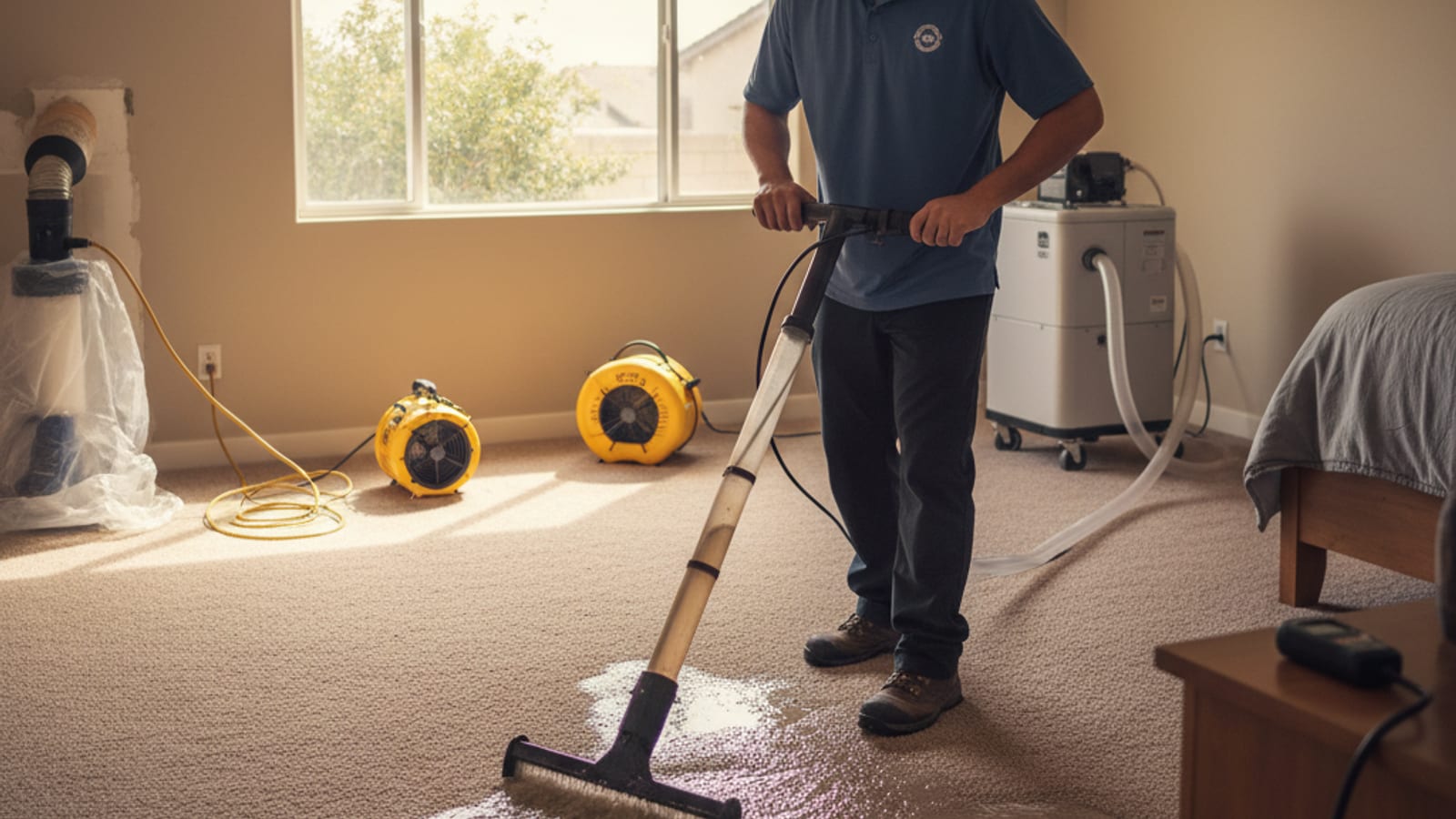
  1. Truck-mount weighted-wand extraction — multiple passes pull bulk water from carpet and pad
  2. Pad cut-out and removal — cut into manageable sections, remove, dispose
  3. Tack-strip preservation — tape and protect during the work
  4. Carpet float drying — air movers placed under the carpet (lifted at the edges) to dry the back side
  5. Antimicrobial application — EPA-registered product applied to carpet, subfloor, and remaining tack strip
  6. New pad installation — typically the next day after subfloor dries to standard
  7. Carpet re-stretch and tack-down — after the new pad is in
  8. Final cleaning — extraction-cleaning to refresh the carpet appearance

Total timeline: 3-5 days from extraction to final tack-down.

Cost breakdown for save vs. replace

For a 200 square foot bedroom carpet:

Save (Cat 1 or Cat 2 under 48 hours)

  • Extraction: $200-$300
  • Drying with air movers: $300-$500 over 3-5 days
  • New pad and install: $100-$200
  • Antimicrobial: $50-$100
  • Re-stretch and tack: $150-$250
  • Total: $800-$1,350

Replace (Cat 3 or extended saturation)

  • Demo and disposal: $150-$300
  • Drying subfloor: $300-$500 over 3-5 days
  • Antimicrobial on subfloor: $50-$100
  • New carpet and pad installed: $1,000-$2,000 (mid-grade)
  • Total: $1,500-$2,900

Insurance covers either path on a covered loss.

What if the homeowner already pulled the carpet?

Common scenario — homeowner pulls up wet carpet and pad themselves before we arrive, hoping to save the substrate. This is fine for clean water; less helpful for Cat 2 or Cat 3 because the homeowner has now spread contamination through the house carrying it out.

If you have already done this, we still come and do the substrate drying and antimicrobial. We will need to assess any path the wet carpet took on the way out.

When to call us vs. handle it yourself

Cat 1 small loss (under 50 sq ft, under 12 hours): a homeowner with a wet/dry shop vac and a fan can sometimes handle it. Cat 1 large loss or any Cat 2 or Cat 3: call.

The economics of insurance also matter — even if you could DIY, calling a restoration company on a covered loss usually means the insurance pays for proper extraction and drying with documentation, while DIY means out-of-pocket and (often) a missed mold problem two weeks later.

Bottom line

Wet carpet often saves on Cat 1 and Cat 2 losses caught fast. Cat 3 always replaces. The pad almost always replaces. We make the call based on the IICRC standard and what we are seeing on site, not on what is profitable.

For an active loss, call us at (858) 808-6055 — 24/7 across San Diego County. See also our carpet water extraction service page.