TL;DR

  • Dishwashers cause more residential water losses in San Diego than any other appliance.
  • Five common failure modes: door gasket, supply line, drain line, internal pump, float switch.
  • Water spreads under the cabinet base toward adjacent cabinets and the wall behind — invisible until you pull the dishwasher out.
  • Insurance treats this as sudden-and-accidental — covered under standard homeowners.
  • Cabinet base, subfloor, and lower drywall are the typical demolition scope; cabinet uppers usually save.

A dishwasher leak is the appliance failure we respond to most often in San Diego. They happen for predictable reasons, they cause damage in predictable patterns, and the cleanup follows a predictable scope. Here is what to do first, what to expect, and what insurance does.

How dishwasher leaks happen

Five common failure modes:

1. Door gasket failure

The rubber seal around the dishwasher door dries out, cracks, or compresses unevenly. Water sprays out the front during the wash cycle, runs down the front of the cabinetry, and pools under the kickplate.

Most common in dishwashers over 8 years old. Easy fix once the leak is identified — gaskets are a $15-$40 part that takes 20 minutes to replace.

2. Supply line failure

The flexible braided line that carries hot water from under the sink to the dishwasher fails. Pinhole leaks, fitting failures, or full bursts.

The supply line is the highest-volume failure — it runs at full house water pressure, so when it goes, hundreds of gallons can spill before the homeowner notices.

3. Drain line failure

The flexible drain hose that carries dirty water from the dishwasher to the kitchen sink drain develops a hole, cracks at a kink, or detaches from the disposal/sink connection. Water spills under the dishwasher and into the cabinet base.

Usually low-volume because the drain only flows during cycle drain phases.

4. Internal pump or motor failure

The dishwasher’s circulation pump, drain pump, or motor seal fails. Water leaks from inside the unit, often from the bottom.

Usually requires replacement of the unit if the pump is shot — repair cost approaches the cost of a new dishwasher.

5. Float switch failure

The float switch tells the dishwasher when to stop filling. When it sticks, the dishwasher overfills and overflows out the door or vents.

Typically a slow leak unless the float fails completely.

What to do in the first 10 minutes

Step 1: Stop the water

If the leak is active, shut off the water supply at the angle stop under the sink. Most dishwasher supply lines tee off the hot water line under the kitchen sink — there is usually a small valve right there. Turn it clockwise to close.

If you cannot find or operate the valve, shut off water at the main shutoff for the house.

Step 2: Cut power to the dishwasher

Trip the breaker for the dishwasher, or unplug it if accessible. Water and electricity together is dangerous. Do not assume the unit is off just because the cycle stopped — control boards can short.

Step 3: Pull what is wet

Open the cabinets adjacent to the dishwasher and inspect the cabinet base. Pull out anything that is wet — pots, cleaning supplies, paper towel rolls. Move them to a dry counter.

Step 4: Document with photos

Wide shots of the kitchen, close-ups of the leak source, photos of standing water and damage to flooring or cabinetry. This is what your insurance adjuster needs.

Step 5: Call us

Dishwasher leaks travel under the cabinet base before they show. Even when the visible water is small, the cabinet base and subfloor underneath are often soaked. We need to be there to extract and dry properly.

Where the water goes

Dishwasher leaks have a predictable damage path:

  1. Cabinet base — the wood base under the dishwasher and adjacent cabinets soaks first
  2. Subfloor — water passes through the cabinet base into the subfloor (plywood or particleboard)
  3. Wall behind — backsplash and drywall behind the dishwasher absorb water
  4. Adjacent cabinets — water tracks under shared cabinet bases to the next cabinet over
  5. Floor finish — eventually surfaces under the kickplate or around the cabinet base, into the kitchen flooring

By the time you see standing water on the kitchen floor, the cabinet base is usually saturated and the subfloor is wet. The drywall behind the dishwasher may be wicking water several feet up.

The cleanup scope

Typical scope for a moderate dishwasher leak:

  • Pull the dishwasher out to assess and dry behind it
  • Extract any standing water in the cabinet base or kitchen floor
  • Remove the kickplate to expose the cabinet base for drying or replacement
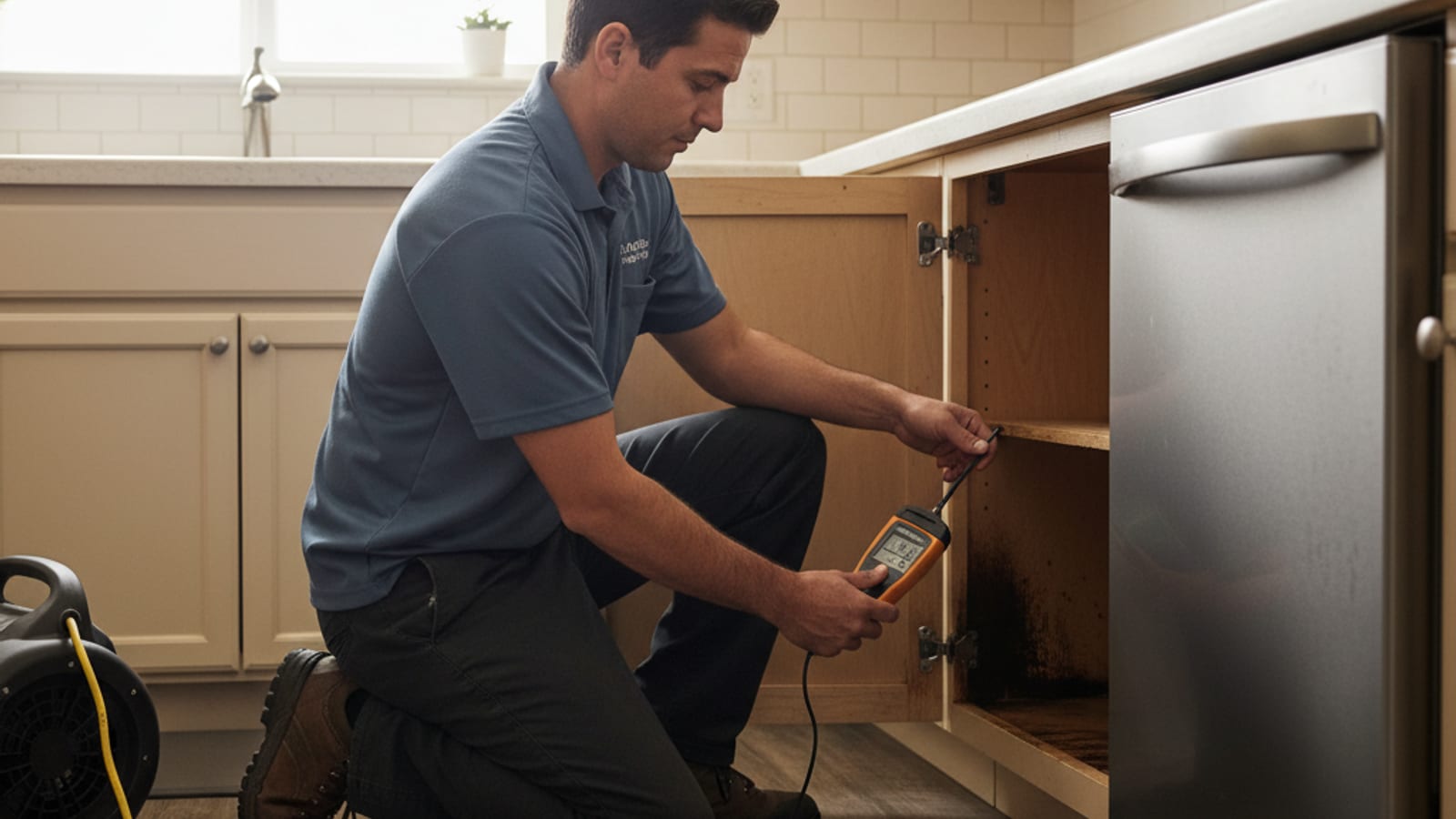
  • Test moisture in cabinet base, subfloor, drywall, and adjacent materials
  • Demo wet cabinet base if particleboard (does not save), wet drywall above the moisture line if Cat 2
  • Dry with air movers and a dehumidifier for 3-5 days
  • Antimicrobial treatment if Cat 2 (most dishwasher water is Cat 2 — gray water with food residue)
  • Rebuild with new cabinet base, drywall, and floor finish coordinated with cabinet maker or your contractor

Most dishwasher water losses are Cat 2 — the water inside the dishwasher contains food particles, soap residue, and bacteria. This means cabinet pads and porous materials below the saturation line typically replace rather than save.

What about the cabinets themselves?

Cabinet base (the floor of the cabinet)

Particleboard cabinet bases (most modern cabinets) absorb water and swell — replacement only. Plywood cabinet bases sometimes save with proper drying.

Cabinet sides and doors

Usually save. The wet damage is almost always limited to the cabinet base; the sides and doors stay dry above the water line.

Cabinet uppers

Almost always save. Water travels horizontally and downward, not up.

The repair often involves replacing just the cabinet bases of affected cabinets — a cabinet maker can fabricate replacement bases that fit the existing cabinet boxes. Cost typically $150-$400 per cabinet for a base replacement.

If the cabinets are very old or low-quality (laminated particleboard with worn edges), full cabinet replacement may make sense — the dishwasher leak becomes the trigger for a partial kitchen update. Insurance pays the like-for-like; the homeowner pays the upgrade differential.

Subfloor and flooring

Plywood subfloor

Often saves with drying. We dry to standard, antimicrobial treat, and reinstall flooring on top.

Particleboard subfloor (older homes)

Usually fails — it disintegrates when wet. Replacement scope adds 1-2 days to the timeline.

Tile floor

Often saves; the water passes through grout but tile bonds usually hold up.

Hardwood

Save odds depend on saturation time. See our hardwood floor save-or-replace article.

Sheet vinyl or LVP

Usually replaces — water under sheet vinyl creates bubbling and adhesive failure that does not reverse.

Insurance specifics

Dishwasher leaks are the textbook sudden-and-accidental loss:

  • Standard homeowners covers the water damage
  • Adjusters usually approve quickly with clear cause-of-loss documentation
  • Direct billing through us simplifies the claim
  • Deductible is the typical out-of-pocket

The dishwasher itself may or may not be covered. Most policies exclude appliance failure (the cause), but cover the resulting water damage (the effect). If the dishwasher is over 10 years old, replacement is usually homeowner expense unless you have appliance-specific coverage.

Bottom line

Dishwasher leaks are predictable, manageable, and almost always covered. Fast response keeps the damage contained to the cabinet base and immediate area; slow response lets water travel under adjacent cabinets and into the wall, multiplying the scope.

For an active dishwasher leak, call us at (858) 808-6055 — we extract fast and document properly for the claim. See also our emergency water extraction service and our first-24-hours guide.