TL;DR

  • Hardwood that has been wet less than 48 hours and sits on dry subfloor usually saves with fast drying.
  • Three damage stages: cupping (curl up at edges, often reversible), crowning (curl up at center, harder), buckling (board lifts off subfloor, usually replacement).
  • Engineered hardwood usually saves; solid hardwood depends on saturation depth and species.
  • Drying takes 7-14 days for hardwood vs. 3-5 days for carpet — patience wins.
  • Refinishing (sanding to fresh wood) is often the post-drying step that brings the floor back.

Hardwood floors and water do not get along. The good news for San Diego homeowners is that the fastest-drying climate in the country gives hardwood the best save odds we see anywhere. The bad news is that hardwood drying is the slowest, most patience-intensive part of any water damage job — and skipping the patience phase wastes the floor.

Here is the actual decision tree we run on hardwood saves.

How water damages hardwood

Wood is hygroscopic — it absorbs and releases moisture in equilibrium with surrounding air. When wet, the wood fibers swell. As they dry, they shrink. The pattern of swelling and drying decides whether the boards stay flat or deform.

Three damage stages:

Cupping (concave at edges)

Boards curl upward at the edges, leaving a slight valley down the middle. Caused by moisture absorbed primarily from underneath (subfloor side) — the bottom expands more than the top. Most common pattern in residential water losses where water gets under the floor through a leak or seepage.

Cupping is often reversible with proper drying followed by refinishing. The floor flattens as moisture equilibrates between top and bottom of each board.

Crowning (convex at edges)

Boards curl downward at the edges, leaving a peak in the middle. Caused by drying too fast on top while the bottom is still wet, or by excessive sanding of a previously cupped floor before it fully dried.

Crowning is harder to reverse. Often happens when DIY drying skips the cavity drying phase and the homeowner sands too soon.

Buckling (board lifts off subfloor)

Boards physically separate from the subfloor and lift up. Caused by severe saturation, prolonged wetness, or failure of the adhesive. Once a board has buckled, it almost never returns to flat — replacement is usually the call.

How fast you respond decides everything

The 48-hour window matters more for hardwood than for any other material. Hardwood that has been wet:

  • Under 24 hours: most floors save with proper drying and refinishing. Cupping mild, no buckling.
  • 24-48 hours: still likely to save, but cupping more pronounced. Drying takes longer.
  • 48-72 hours: 50/50. Some boards save, some replace.
  • Over 72 hours: most often replacement, especially with Cat 2 or Cat 3 water.

Calling within hours of discovery is the difference between a $2,000 refinish and an $18,000 floor replacement.

Engineered vs. solid hardwood

Engineered hardwood

Multiple plies bonded together, with a hardwood veneer on top. The plies counteract each other’s expansion, making engineered hardwood more dimensionally stable when wet. In most water losses, engineered hardwood saves more often than solid.

The exception: if the moisture penetrated to delaminate the plies, the boards have to come out. Once delamination starts, drying does not reverse it.

Solid hardwood

Tongue-and-groove boards milled from a single piece of wood. More expensive, more dimensional movement when wet. The save depends heavily on:

  • Species: oak and maple are more forgiving than walnut or exotic species
  • Finish: site-finished floors with multiple coats of poly are more water-resistant than pre-finished
  • Subfloor: floors over plywood subfloor save more often than floors over concrete (concrete holds moisture against the bottom of the boards)

The drying process for hardwood

Hardwood drying is not the same as carpet or drywall drying. Equipment and timeline differ.

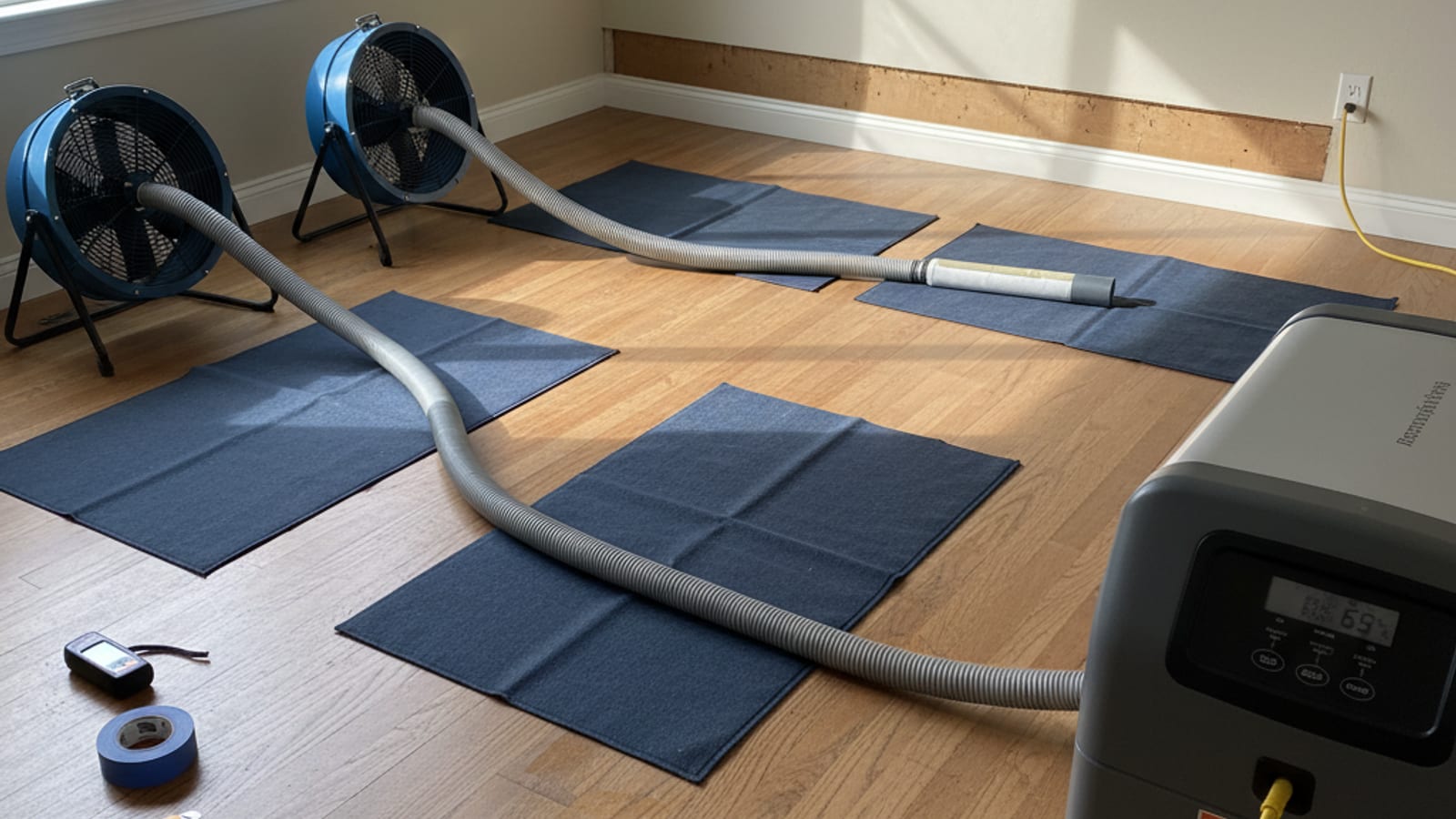
Floor mats

Specialty floor mats laid directly on the wet hardwood pull moisture from the surface and from the subfloor below. The mats connect via hose to a dehumidifier that creates low pressure under the mat, drawing moisture out. Standard for hardwood saves.

Cavity drying

If the subfloor is also wet, we drill small holes into adjacent walls or unfinished spaces and run InjectiDry hoses to dry the cavity below the floor. Without this, top-side drying alone often crowns the floor as it dries unevenly.

Patience

Hardwood drying takes 7-14 days for most jobs, sometimes 3 weeks. We monitor moisture content daily with pin-style meters — targets are 8-12% moisture content depending on species and depending on the dry baseline reading from undamaged areas. We do not pull equipment until the readings hit target.

Refinishing as part of the save

Even when drying succeeds, the surface usually needs refinishing to look right again. The water leaves staining, the cupping leaves slight ridges, the finish discolors.

Refinishing scope after a water loss:

  1. Sand down to bare wood — typically 80-grit, then progressively finer
  2. Stain match — to existing un-affected sections of the floor
  3. Multiple coats of polyurethane — water-based or oil-based, 2-3 coats with screening between
  4. Cure time — 24-48 hours before light foot traffic, 2 weeks before furniture

Most hardwood saves we do end with refinishing. Cost typically $3-$6 per square foot for refinishing, depending on the species and the level of sanding required.

When replacement is the right call

Replacement is typically right when:

  • Boards have buckled — lifted off the subfloor
  • Board ends are split or splitting
  • Subfloor underneath is delaminating
  • Water was Category 3 (sewage, flood) — porous wood with pathogen exposure does not save
  • Drying has run 14+ days without reaching dry standard
  • The damaged section is small enough that match-replacing it is cheaper than refinishing the whole room

Replacement cost runs $8-$15 per square foot installed for like-for-like replacement, plus refinishing the surrounding area to blend.

Insurance coverage

Hardwood floor damage from a covered water loss is covered the same as any other material. The carrier pays for:

  • Drying scope (equipment days, monitoring, technician time)
  • Refinishing if drying succeeds
  • Full replacement if drying fails
  • Adjacent room blending if needed for color match

Match-replacement is the part that gets negotiated most often. Adjusters sometimes try to scope only the wet boards; we document the case for full-room replacement when a partial replacement would leave a visible color or stain mismatch. Most reasonable adjusters approve full-room blending when the case is clear.

What you can do before we arrive

  • Lift everything off the wet area — furniture, rugs, anything that traps moisture against the floor
  • Do not put fans on the floor surface — fast top-side drying without subfloor drying causes crowning
  • Do not refinish or sand any time soon — even months. Wood needs to fully equilibrate first
  • Open the windows on dry days — moderate ambient humidity helps; high humidity hurts

Bottom line

Hardwood floors are recoverable on most water losses caught fast. The decision is patience: hardwood drying takes 2-3x longer than carpet, and the floor needs that time to flatten properly. Refinishing finishes the job.

For an active water loss with hardwood floors, call us at (858) 808-6055 — the faster you call, the better the save odds. See also our structural drying service page and our first-24-hours guide.