TL;DR
- Sewage carries E. coli, hepatitis A, salmonella, and parasites — Category 3 black water by IICRC standard.
- DIY cleanup risks illness and spreads contamination to areas you have not realized you have touched.
- Standard homeowners excludes sewer backup unless you have a specific endorsement (typically $40-$80/year).
- Anything porous below the contamination line comes out — drywall, carpet, pad, fiberglass insulation, particleboard.
- Hard non-porous materials (tile, sealed concrete, finished wood) can be cleaned and sanitized in place.
A toilet overflows, and within 30 minutes the bathroom is a containment problem. A main line backs up while you are at work, and you come home to a finished basement that smells like a treatment plant. A septic system fails during a multi-day storm, and the yard saturates. All three are Category 3 events. None of them are DIY jobs.
Here is what is actually happening biologically, why the cleanup protocol exists, and what insurance does and does not cover in San Diego.
What “Category 3 black water” means
The IICRC S500 standard classifies water losses into three categories based on contamination:
- Category 1 (clean water) — supply line breaks, ice maker overflows. Drinkable in origin.
- Category 2 (gray water) — washing machine overflows, dishwasher discharges with food residue. Significant microbial content.
- Category 3 (black water) — sewage, flood from outside, water that has been sitting more than 48 hours and grown microbial. Includes pathogens.
Sewage is Category 3 by definition regardless of how clean it looks. So is flood water from outside the home. So is water from a toilet that has been used recently — the moment a toilet overflows past the rim, the spread is Cat 3 even if it looks like clean water.
What is in Cat 3 water:
- E. coli — bacterial infection, usually GI symptoms, can be severe
- Hepatitis A — liver virus, weeks to months of illness
- Salmonella — GI, fever, severe in immunocompromised people
- Giardia and cryptosporidium — parasites, weeks of GI symptoms
- Norovirus — highly contagious, “stomach flu”
- Various other bacteria — staph, strep, environmental species
In small concentrations, healthy adults often shake these off without knowing. In real concentrations from an actual sewage event, they cause real illness. Children, elderly, pregnant, and immunocompromised people are at highest risk.
Why DIY cleanup makes it worse
Three problems:
1. You spread the contamination
Cleaning sewage with household tools and clothes — mops, towels, regular vacuums, your shoes, your gloves — spreads pathogens to areas you did not realize you touched. The kitchen, the bathroom you used during cleanup, the laundry room where you washed the towels. Now those areas need cleaning too.
2. You miss the porous-material rule
Cat 3 water saturates porous materials — drywall, carpet, fiberglass insulation, particleboard, paper-faced ceiling tiles. These materials cannot be sanitized; the pathogens penetrate the structure. They have to come out.
DIY usually skips this step (it is the expensive, demolition-heavy part of the job) and just cleans surfaces. Two weeks later, the walls smell. Mold grows. Health complaints start.
3. You bypass the proper protocol
The IICRC S500 protocol for Cat 3 water:
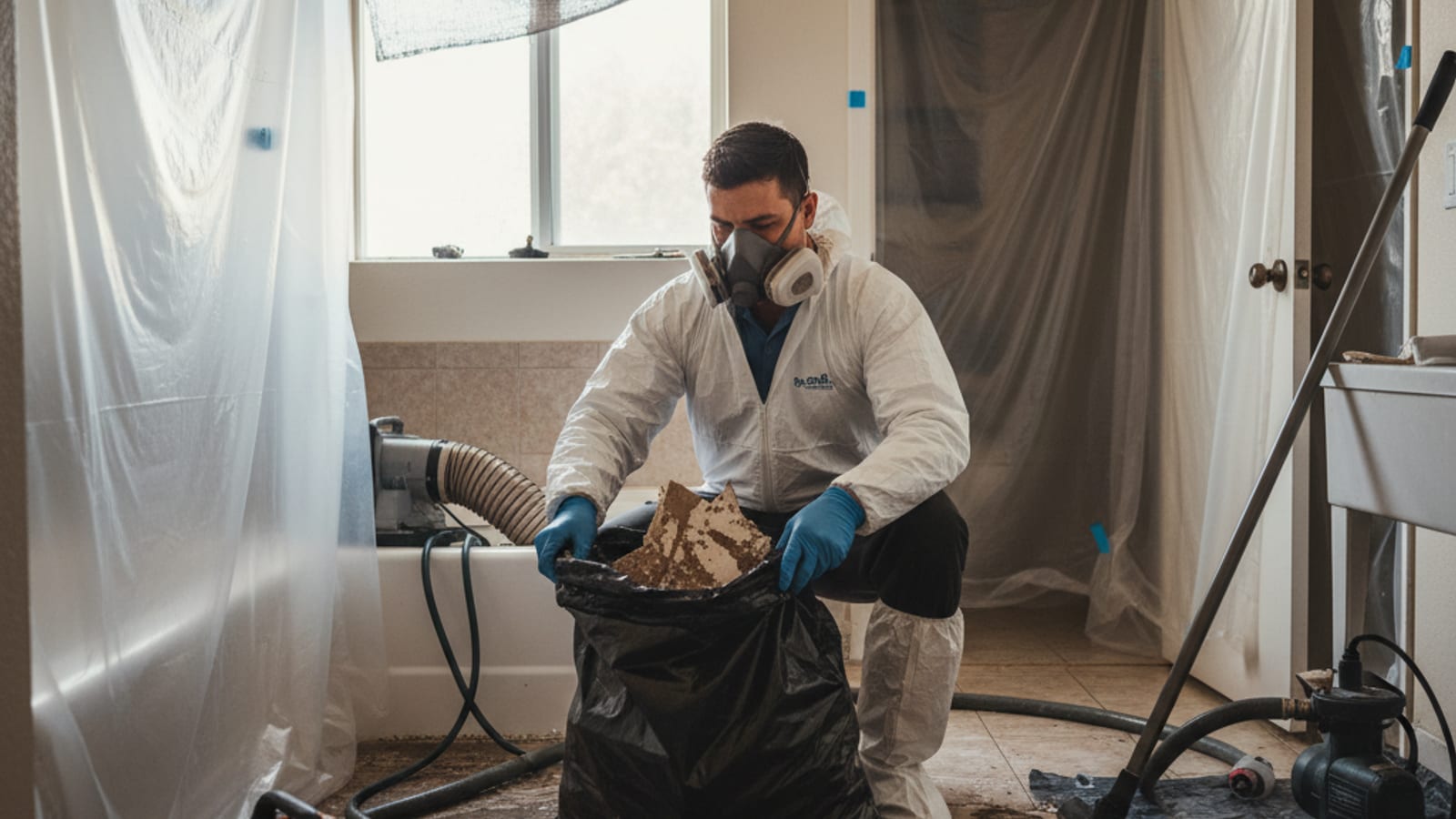
- Containment — barriers and negative air to keep contamination from spreading
- PPE — respirators, Tyvek suits, gloves, boot covers
- Bulk extraction — sewage and contaminated water out
- Demolition — porous materials below the contamination line
- Cleaning — multiple passes on hard surfaces with EPA-registered antimicrobial
- Drying — to dry standard, with daily moisture readings
- Optional clearance testing — independent industrial hygienist samples
Each step has a reason. Skipping any of them either spreads contamination, leaves contamination in place, or both.
What gets thrown out vs. cleaned
Thrown out (porous materials)
- Carpet and pad below the contamination line
- Drywall up to two feet above the contamination line
- Fiberglass insulation
- Particleboard, MDF, and other compressed wood products
- Paper-faced ceiling tiles
- Fabric upholstery and mattresses (case-by-case)
- Paper records and books that touched the water
Cleaned in place (hard non-porous)
- Tile and grout (with multiple sanitization passes)
- Sealed concrete
- Finished wood (sometimes — depends on saturation)
- Glass, metal, plastic
- Sealed cabinetry exteriors
Borderline (semi-porous)
- Hardwood floors — sometimes saved with proper drying and antimicrobial; sometimes have to come out
- Dimensional lumber framing — usually saved with antimicrobial and proper drying
- Subfloor (plywood, OSB) — case-by-case, depends on category and saturation time
We make these calls based on the IICRC standard and what we are seeing in the moisture readings, not on what is profitable. Saving materials when the science allows is part of the job.
Insurance specifics for sewage backup
Standard homeowners policies in California typically exclude sewer and drain backup unless you have a specific endorsement:
- Sewer Backup Coverage or Service Line Coverage — typically $40-$80/year add-on
- Limits — typically $5,000-$25,000
- Coverage — sewage backup from blocked main line, sump pump failure, drain backup
Without the endorsement, sewage cleanup is out of pocket. Check your declarations page for “sewer backup,” “service line,” or “water backup” coverage. If it is not on there, call your agent — for the cost ($40-$80/year on most policies), it is among the higher-value endorsements available.
Septic system failures may or may not be covered depending on the cause. Sudden mechanical failure (tank lid crack, pump failure) often is. Long-term seepage and overflow from neglected maintenance often is not.
Cost overview
Sewage cleanup pricing depends on the affected area, contamination spread, and demolition scope. Rough ranges:
| Scope | Range |
|---|---|
| Single bathroom, contained | $1,800-$3,500 |
| Bathroom + adjacent room | $3,500-$6,000 |
| Multi-room or basement | $6,000-$15,000 |
| Whole-house sewer overflow | $15,000+ |
Most carriers approve sewage scope on covered claims with proper documentation.
What to do if you have an active sewage backup
- Leave the area. Pathogens are airborne and surface-contact. Do not stand in it.
- Cut HVAC if any registers are in or near the affected area — circulating contaminated air spreads spores.
- Cut power to the affected area at the breaker if water is near outlets.
- Photograph without entering the contamination zone.
- Call us. We arrive in PPE, contain the area, and start the proper protocol.
- Do not flush, do not run water in the home until we identify and isolate the source.
If the cause is a main line clog, a plumber clears the clog; we handle the cleanup. We coordinate.
Bottom line
Sewage cleanup is Category 3 work that requires proper PPE, containment, and the IICRC S500 protocol. DIY attempts make the job harder for the next people who arrive (us) and create real health risks for the family in the meantime.
If you are dealing with an active backup, call us at (858) 808-6055. We arrive in PPE, contain the area, and bill insurance directly when coverage applies. See also our sewage cleanup service page.