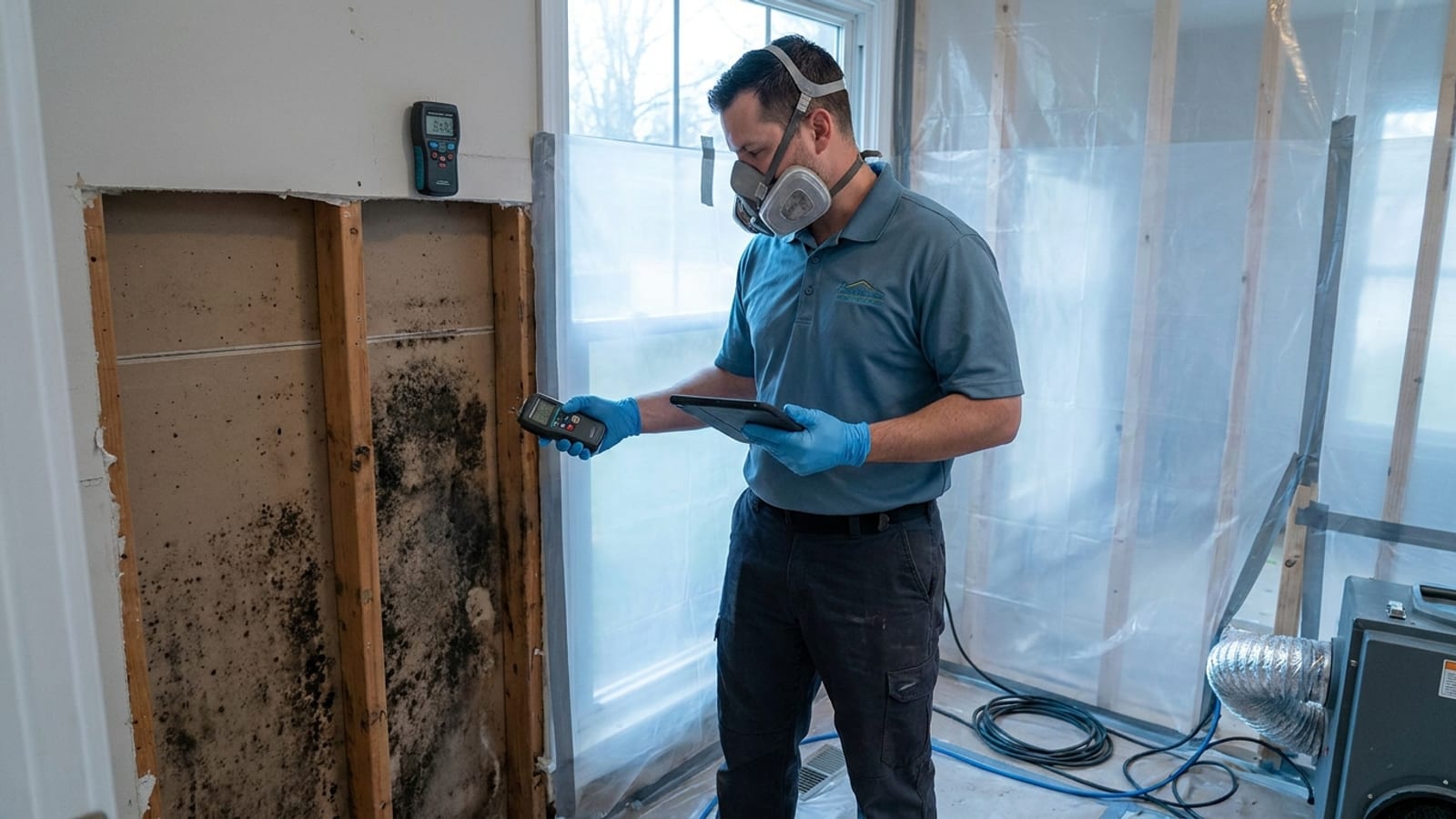
You pulled back the bathroom vanity, or peeled up a corner of damp drywall, and found something dark and splotchy staring back at you. Now your mind is racing through everything you’ve ever heard about “black mold.” Take a breath. The reality is more straightforward than the headlines suggest, and understanding it will help you make better decisions right now.

What people mean when they say “black mold”

“Black mold” is a popular term that almost always refers to Stachybotrys chartarum, a specific mold species that gets the most media attention. The problem is that the name is doing a lot of work it can’t deliver on. Hundreds of mold species can appear dark green, dark gray, or almost black. Cladosporium, Aspergillus, and Penicillium are all common household molds that can look black or very dark to the naked eye. Color alone tells you nothing definitive about the species, and the species alone doesn’t tell you the risk level.

The only way to know what you’re actually dealing with is to have a professional collect a sample and send it to a certified lab. Even then, the practical takeaway is the same for most moisture-related mold: you have a water problem that created a mold problem, and both need to be addressed. The focus on species identification often distracts homeowners from the more important question, which is what’s feeding the mold growth and how far has it spread.

The real health effects of mold exposure

Mold doesn’t need to be Stachybotrys to affect how you feel. Any mold growing indoors produces spores, and those spores can irritate your respiratory system. Common effects reported by people exposed to mold in their homes include nasal congestion, coughing, throat irritation, and watery or itchy eyes. For people who already have asthma or environmental allergies, mold exposure can trigger more frequent or more severe symptoms.

Certain groups are more sensitive: infants, elderly adults, people with compromised immune systems, and anyone with a pre-existing respiratory condition. If someone in your household fits that description, a mold problem deserves faster attention than it might for a healthy adult with no underlying conditions.

Stachybotrys does produce mycotoxins, which are compounds that sound alarming in news coverage. What the coverage often leaves out is that significant mycotoxin exposure typically requires prolonged contact with heavily contaminated materials in an enclosed space. The kind of mold patch a San Diego homeowner finds on a bathroom wall or under a kitchen sink is a different situation than a flooded building with saturated materials that sat wet for weeks. That’s not a reason to ignore it. It’s a reason not to catastrophize before you know what you’re dealing with.

If you or your family are experiencing symptoms you suspect are mold-related, talk to a doctor. That’s not something we can advise on, and anyone telling you a specific mold patch is definitely causing your specific symptoms without proper testing is giving you information they can’t back up.

Why the moisture problem matters more than the mold species

Here’s the straightforward truth: mold is everywhere. Spores float through the outdoor air in San Diego just like anywhere else. They land on surfaces constantly. What determines whether mold colonizes a surface and becomes a problem is moisture. Without an ongoing moisture source, mold can’t get established and grow.

This means that when you find mold in your home, the mold itself is a symptom. The root cause is water. It might be a slow pipe leak inside a wall. It could be condensation accumulating in a poorly ventilated bathroom or laundry room. In San Diego’s older coastal neighborhoods, especially those with stucco exteriors in Oceanside, Encinitas, or parts of La Mesa, it’s sometimes moisture intrusion through aging exterior walls during our marine-layer months or after an atmospheric-river storm. Slab-on-grade homes can also have moisture wicking up through concrete that keeps subfloor areas perpetually damp.

Fix the moisture source and the mold stops getting fed. Skip fixing the moisture source and the mold will come back, no matter how thoroughly the surface was cleaned. This is why water damage restoration and mold remediation go together. Treating one without the other leaves the job half done.

What you should not do when you find mold

Two things homeowners commonly do that make the situation worse: bleaching the surface themselves, and disturbing the mold by scraping or pulling materials apart.

Spraying bleach on visible mold does kill surface growth on non-porous materials like tile. On porous materials like drywall, wood framing, and grout, bleach doesn’t penetrate far enough to reach the root structure (hyphae) of the mold. You end up with a temporarily lighter surface and a still-active mold colony. More importantly, bleach doesn’t solve the moisture problem that allowed the mold to grow in the first place.

Disturbing mold by scraping, sanding, or tearing out materials without containment releases a large number of spores into the air at once. Those spores then travel through your HVAC system and land on surfaces throughout the house. What started as a contained patch in one bathroom can end up as a much larger problem in other rooms. This is exactly why the professional mold remediation process involves setting up containment barriers, using negative air pressure, and wearing proper respirators before any material removal begins.

If the affected area is small (think a few square inches of surface mold on a tile that’s clearly damp from a simple ventilation issue), careful cleaning with appropriate products can be reasonable for a healthy adult. If the area is larger than roughly 10 square feet, if it’s inside a wall or ceiling cavity, or if you can smell mold but can’t see where it’s coming from, call a professional before doing anything else.

When to be genuinely concerned

Some situations call for faster action. Be more urgent if:

The mold covers a large area, especially one that’s been growing in a hidden space for an unknown amount of time. Mold can start forming within 24 to 48 hours of a moisture event, which means a slow leak that went undetected for months may have colonized a significant area of wall cavity or subfloor.

You can smell musty odors but can’t find a visible source. That’s a strong indicator that mold is growing inside a wall, under flooring, or in an HVAC component. Hidden mold is typically more extensive than surface mold, and identifying it requires moisture meters and sometimes thermal imaging cameras.

Someone in the home is experiencing symptoms that improve when they leave and return when they come back. That pattern is worth mentioning to a doctor and worth investigating with a professional inspection.

The moisture source was related to flooding, sewage backup, or a sustained leak that saturated building materials. Category 3 (black) water from sewage or flooding carries contamination beyond just mold. Water damage restoration from those events requires a different level of response than a small clean-water leak.

What professional mold remediation actually looks like

A professional remediation job isn’t a mystery. The process is methodical and follows well-established industry standards. It starts with an assessment: identifying the source of moisture, mapping the extent of mold growth using moisture meters and visual inspection, and sometimes air or surface sampling if the scope is unclear.

From there, the work area gets contained. Plastic sheeting seals off the affected area from the rest of the house, and a negative air machine creates lower pressure inside the containment zone so air flows inward rather than outward. That keeps spores from spreading to unaffected areas during the removal work.

Porous materials with significant mold growth, typically drywall, insulation, and sometimes wood framing, get removed and bagged for disposal. Non-porous surfaces get cleaned with antimicrobial products. HEPA vacuums capture fine particles. After removal and cleaning, the area gets a final air clearance test to confirm spore counts are back to normal levels before containment is removed.

The moisture source gets addressed either by the remediation team or in coordination with a plumber or contractor, depending on what caused it. If water damage restoration work is also needed (drying out wet materials, repairing damaged flooring or drywall), that typically happens in the same project.

If you’re wondering what this costs, mold remediation cost varies depending on the size of the affected area, the materials involved, and how much access work is required to reach hidden growth. Small, contained jobs are in a different range than situations where mold has spread through multiple wall cavities.

When to call us

If you’ve found what looks like mold, especially in a spot that’s been wet for a while, don’t disturb it and don’t wait to see if it goes away on its own. It won’t. Get a professional assessment so you understand the actual scope before deciding on a course of action. If the moisture source involved any kind of water damage event, a leak, a flood, a plumbing failure, addressing the underlying damage is part of fixing the problem.

Our team handles both sides of this. We assess moisture damage, dry out affected materials, and coordinate mold remediation so you’re not managing two separate contractors trying to solve half of the same problem.

Call us at (858) 925-5546 for a same-day estimate.