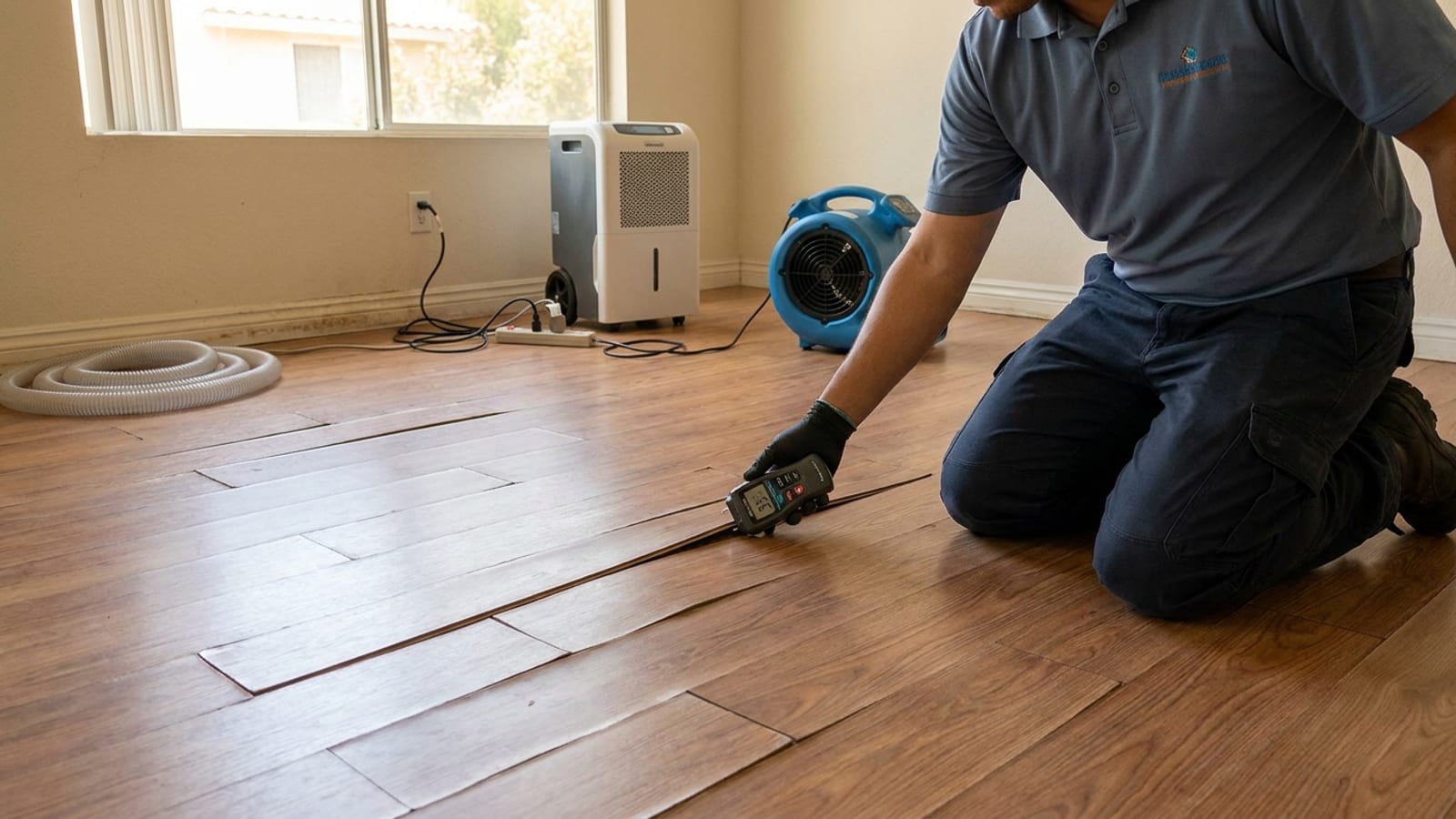
You walked into the kitchen and felt it before you saw it. That soft, spongy give underfoot. Or maybe you noticed the planks lifting at the seams, the edges curling up in that unmistakable way. However you found the water, you’re now standing over wet laminate flooring wondering whether you can dry it out and move on, or whether you’re looking at a full replacement. Here’s the honest answer.

Why laminate responds to water so differently than other floors

Laminate isn’t wood. It looks like wood, it’s priced like wood, but underneath the photographic wear layer is a core made of high-density fiberboard (HDF). That core is essentially compressed wood fibers and glue. It’s good at resisting surface scuffs and everyday spills, but it has one serious vulnerability: it absorbs water.

When water gets into HDF, the fibers swell. They swell fast and they swell unevenly. That’s what causes the buckling, the lifting at the seams, the edges that curl up or push into each other. Once those cells have swollen, they don’t shrink back to their original dimensions when they dry. The damage is structural, not just surface-level.

This is the key difference between laminate and solid hardwood. With hardwood, the wood can often be dried, then sanded and refinished back to a flat surface. Laminate can’t be refinished. There’s no wear layer thick enough to sand, and once the HDF core has swollen and delaminated, the plank is done. So the question of “save or replace” mostly comes down to one thing: did water actually penetrate the core?

The two scenarios that determine everything

Scenario one: a surface spill, wiped up fast. A glass of water tips, a mop leaves puddles, or a small leak drips for an hour before you catch it. The water sits on top of the laminate. You wipe it up within minutes, maybe within the first hour. In this case, if the floor looks flat and the seams haven’t lifted, the core probably didn’t get saturated. Laminate has a surface coating that resists brief contact. Dry the surface completely, monitor for a day or two, and the floor may be fine.

Scenario two: standing water, a longer leak, or saturation from below. A washing machine line fails. A slow slab leak saturates the pad and subfloor from underneath. A toilet overflows and nobody’s home for hours. The water finds its way into the seams, and once it’s in the seams, it’s in the core. At that point, even if you extract all the standing water and run driers for a week, the planks that got wet have already swollen. They’re not going back. Replacement is the answer.

Most homeowners dealing with a true water event, not a quick spill, are in scenario two. Leaks that go undetected for any length of time almost always result in water that has worked its way into the joints.

What to look for when assessing the damage

If you’re not sure which scenario you’re in, look at the floor. Buckled planks, seams that have risen or separated, and edges that are curling upward are all signs that the HDF core has already swollen. Press down on suspect areas. If the floor flexes in ways it didn’t before, or if you hear a hollow sound that wasn’t there, moisture is under the planks.

A moisture meter is the most reliable tool for this assessment. We use them on every job because eyes alone don’t tell the full story. The laminate surface may look dry while the core and the subfloor underneath are still holding significant moisture. If readings are elevated, you’re dealing with saturation, and the floor needs to come up.

Also check the edges and around the perimeter. Water travels. In a slab-on-grade home (common across Chula Vista, El Cajon, and older neighborhoods throughout San Diego County), moisture can wick up from below through the concrete, especially after heavy atmospheric-river rains or a plumbing failure. The laminate at the perimeter often absorbs moisture from the walls and baseboards before the center of the room shows visible signs.

The subfloor problem that most homeowners miss

Here’s where people get tripped up: even if you decide to replace the laminate, the job isn’t done when the old planks are in the dumpster. The real concern is what’s underneath.

Most laminate installations sit on a foam or cork underlayment pad. That pad is usually the first thing to absorb water from above, and it holds moisture like a sponge. Below the pad is the subfloor, typically OSB or plywood on a wood-frame structure. OSB is particularly vulnerable to water. It swells, delaminates, and loses structural integrity quickly. If the subfloor has gotten wet, it needs to be fully dried before any new flooring goes down. In some cases, sections of OSB need to be replaced entirely.

Installing new laminate or any other flooring over a wet or compromised subfloor is one of the most common mistakes we see. The new floor traps the moisture, the subfloor continues to deteriorate, and mold develops in the dark, damp cavity between them. The homeowner has new floors and a growing problem they can’t see.

Structural drying is the process of removing moisture from the building materials themselves, not just the air, and it has to happen before any repairs or reinstallation. We use industrial dehumidifiers and air movers placed strategically to pull moisture out of subfloors, wall bases, and any adjacent materials that got wet. We monitor daily with moisture meters until readings return to acceptable levels. This part of the job is not optional.

How laminate compares to hardwood and carpet in water events

It’s worth knowing how this plays out for other floor types so you have the full picture.

Water-damaged hardwood floor: save or replace gets into this in detail, but the short version is that solid hardwood has more recovery options than laminate. It can be dried carefully, and if it’s cupped or slightly warped, a refinish can often flatten the surface back out. That doesn’t mean hardwood always survives, but the wood fibers are real wood all the way through, which gives restorers more to work with. Engineered hardwood sits somewhere in between, depending on the thickness of the wear layer.

Carpet in a water event is a different calculation. Clean-water events caught quickly often allow carpet to be saved through extraction and drying. The bigger concern with carpet is always the pad, which has to come out because it doesn’t dry in place. Category 2 or 3 water (gray or contaminated water, including anything from a toilet, sewage backup, or prolonged standing water) means the carpet goes, no exceptions.

With laminate, the calculus is simpler than either of those. If the core absorbed water, the plank is done. There’s no gray area about refinishing and no partial recovery path.

What a proper restoration looks like

When we respond to a water event involving laminate floors, the process starts with moisture mapping. We measure the floor, the pad if it’s accessible, the subfloor, and the walls along the perimeter to understand the full extent of the saturation. We document everything with readings and photos, which also helps when you’re working through an insurance claim.

If the laminate planks have swollen or lifted, they come up. This usually isn’t salvageable material, but removing it lets us get to the subfloor and the underlayment, which are the priority. We pull the wet pad, assess the subfloor, and set up the equipment, including high-capacity dehumidifiers and directional air movers, to dry the structure down to acceptable moisture levels.

The water damage restoration process takes several days for most floor jobs. Rushing it is the single biggest mistake. We see people who had another company come in, pull the wet laminate, and then re-floor within a day or two. Six months later they’ve got mold under their new floors and a significantly more expensive problem. We run the equipment until the numbers say it’s done.

Once the subfloor is confirmed dry and structurally sound, new flooring can go in. If you’re replacing the laminate, this is often a good moment to consider whether a more water-tolerant option, like luxury vinyl plank, makes sense for areas that see regular moisture exposure (kitchens, laundry rooms, bathrooms). That’s not a sales pitch, just a practical note from having seen a lot of laminate failures over the years.

When to call a restoration company

If you’re dealing with anything beyond a spill wiped up within minutes, the job is bigger than a fan and a mop can handle. Standing water, a leak you discovered after the fact, or laminate that’s already buckling means you need moisture readings, proper extraction, and drying equipment that most homeowners don’t own.

The 24 to 48 hour window for mold growth is real. San Diego’s marine-layer humidity doesn’t help things dry out on their own, especially in coastal communities from Oceanside down to Coronado. The faster the wet materials are dealt with, the better the outcome for both the floor and the structure underneath it.

Call us at (858) 925-5546 for a same-day estimate.