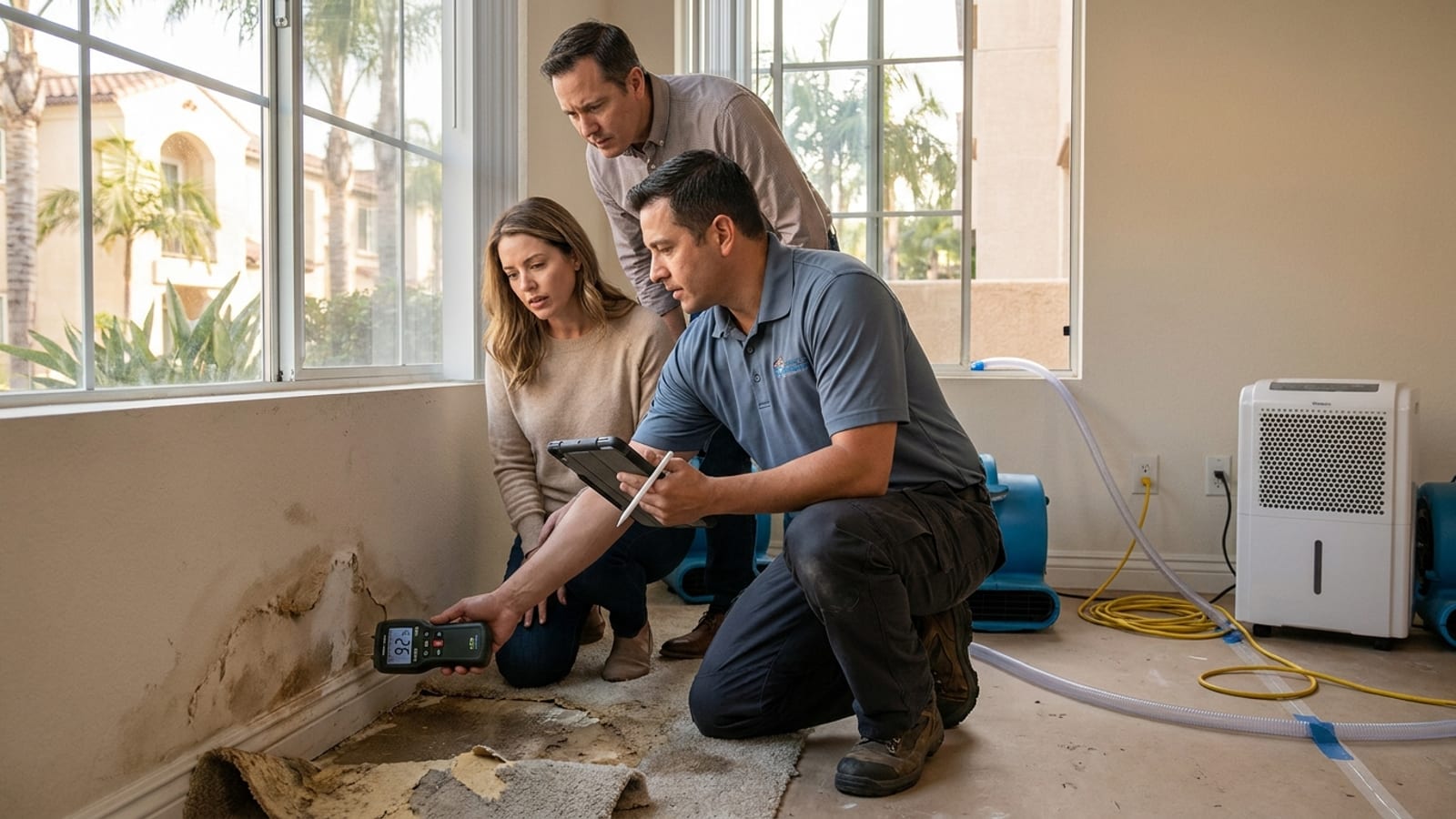
You woke up to water on the floor, a soaked ceiling, or a flooded bathroom. The next question is almost always the same: who pays?
This is general information about California Civil Code, not legal advice. If the dispute is large, talk with a California tenant-landlord attorney or a tenant-rights group before you withhold rent or hire work yourself.
Direct answers
Who pays to dry and repair the building? If the leak came from the roof, exterior walls, plumbing, or other building systems the landlord must keep in repair, California Civil Code section 1941 says the landlord has to put the unit in a condition fit for occupation and repair dilapidations that make it untenantable. Section 1941.1 treats missing waterproofing, plumbing that is not in good working order, and floors that are not in good repair as untenantable conditions.
Who pays for the couch, clothes, and laptop? The landlord’s duty under Civil Code 1941 is the building. Belongings the tenant brought in are a separate question. Renters insurance is the usual way tenants cover furniture, electronics, and clothes. Read the actual policy. Do not assume a landlord policy pays for those items.
Who pays if the tenant caused it? Civil Code section 1929 says the person hiring the property must repair injuries caused by a lack of ordinary care. An overflowed tub, a window left open in a storm, or a supply line the tenant damaged can land on the tenant.
What should you do in the first hour? Get people out of standing water. If you can reach the main breaker without walking through water, shut power off. If you cannot, leave it and call an electrician. Stop the water at the shutoff if you can do that safely. Photograph every wet surface. Notify the landlord in writing the same day. EPA guidance is to fix plumbing leaks as soon as possible and dry items completely. Sewage or other contaminated water is a job for a professional experienced with that kind of damage.
California Civil Code 1941 and 1941.1, in plain terms
Section 1941 is the baseline: a landlord of a building meant for people to live in must keep it fit to occupy and repair later problems that make it untenantable, except damage the tenant caused under section 1929.
Section 1941.1 then lists what “untenantable” includes. For a water loss, the relevant items are:
- Effective waterproofing and weather protection of the roof and exterior walls, including unbroken windows and doors.
- Plumbing maintained in good working order.
- Floors, stairways, and railings maintained in good repair.
A burst supply line, a failed roof during an atmospheric-river storm, or a swollen subfloor after a leak is not a decorating issue. It is a habitability condition the landlord has to address.
That still does not mean the landlord replaces the tenant’s mattress.
Building versus belongings
The landlord owns the walls, floors, ceilings, plumbing, built-in appliances, and the roof. When those fail, the landlord is responsible for water damage restoration of the structure.
The tenant owns furniture, electronics, clothing, and anything brought into the unit. If a pipe bursts in a Chula Vista apartment and ruins a mattress and a laptop, the landlord’s statutory repair duty is about the wall and the subfloor, not replacing the tenant’s property. Renters insurance, if the tenant has it, is the usual path for the mattress and laptop. Read the policy.
This split is the fight that shows up after almost every rental flood. Tenants often assume the landlord covers everything. Landlords sometimes push back on structural work they are required to handle. Naming the split early saves both sides a week of argument while the drywall is still wet.
If the tenant caused it, or if nobody agrees
Section 1929 is short. Injuries from a lack of ordinary care fall on the renter.
If a building system failed: a roof, an aging water heater the landlord owns, or a corroded pipe in the wall. Those are the landlord’s repair. If the unit is uninhabitable, tenants have statutory remedies, including the repair-and-deduct path in section 1942. Use that path only after you understand the limits below.
If the tenant caused it: a bathtub overflow, a window left open, a washing machine the tenant hooked up badly. Repair costs for that damage can fall on the tenant. Renters insurance may cover some of it. Read the policy.
If it is unclear: an older El Cajon fourplex with original plumbing is going to produce disputed leaks. Document the source, the date, and every conversation. That record is what an insurer or a small-claims judge actually uses.
Repair-and-deduct has a hard cap (Civil Code 1942)
Pages that outrank generic “who pays” posts usually name this statute. Here is what it actually says.
After written or oral notice of dilapidations the landlord ought to repair, if the landlord neglects to do so within a reasonable time, the tenant may:
- Repair the problem themselves if the cost is not more than one month’s rent, then deduct that expense from rent when it is due, or
- Vacate, and stop owing further rent as of the date they leave.
The tenant may not use this remedy more than twice in any 12-month period.
If the tenant waits until after the 30th day following notice, the law presumes that was a reasonable wait. That presumption can be rebutted. A shorter wait is allowed when the circumstances require it, which is how a serious flood is treated compared with a slow drip.
The remedy is not available if the condition was caused by a violation of section 1929 or 1941.2. In other words, you cannot repair-and-deduct your own careless damage.
Do not hire a restoration company and deduct the bill unless you have followed this statute and the cost truly fits under one month’s rent. Do not assume extraction and drying will cost less than one month’s rent. Talk with counsel or a tenant-rights group first.
Withholding rent is a different, riskier path. This article does not walk you through it. Get advice before you stop paying.
Your duty to report, and why it changes the bill
Tenants have to tell the landlord about conditions that need repair. If a slow leak under the sink sits for two weeks with no notice, an adjuster may treat later cabinet and wall damage as partly the tenant’s problem.
Report it in writing the same day. Email or a dated letter is better than a phone call you cannot prove. State what you saw and when.
EPA guidance is to stop the leak and dry completely. Contaminated water, including sewage, is not a mop-and-fan job. Call a professional experienced with that damage.
If the landlord does not act after notice, section 1942 is the numbered repair-and-deduct tool. Keep the paper trail. Without it, the statute is hard to use.
What the landlord has to start after notice
For a habitability water loss, acting means:
- Stop the source if it is a building system.
- Arrange emergency water extraction and drying of the structure through an independent restoration professional.
- Repair damaged walls, flooring, ceilings, and built-in fixtures.
The landlord is not required to replace the tenant’s belongings. Hotel coverage is a policy and lease question, not something section 1941 automatically buys. If the unit is unlivable, reduced rent or leaving under 1942 may be the statutory path. That is not the same as a hotel voucher.
The person who owns the building is the one who should authorize structural restoration. A tenant who lets workers in without the landlord’s approval can end up in a three-way billing fight. Restore Pro SD matches callers with licensed independent restoration professionals. The customer contracts and pays that professional directly.
Mold follows water that was not dried
EPA’s published cleanup advice is to fix water problems quickly and dry items completely. If sewage or other contaminated water caused the damage, call a professional experienced with that work.
Notify the landlord in writing and photograph what you see. Do not wait for a lab kit before you report standing water or wet walls. Catching moisture early is cheaper than opening walls later.
If you need the restoration side of that work, start with mold remediation after the source is stopped.
Insurance: two different contracts
Civil Code 1941 is about repairing the unit. It is not an insurance statute.
A landlord may carry property insurance. A tenant may carry renters insurance. What either policy pays depends on the contract, the cause of loss, and whether the leak was sudden or gradual. Read the actual policy. Do not treat this page as coverage advice.
When both sides are filing claims, the insurance claim process post covers the documentation sequence. Photograph everything before anyone starts tearing out wet material. A written assessment from the independent professional belongs in both the insurance file and any later dispute file.
Check the lease, then keep a dated log
Section 1941 requires the landlord to repair, in the absence of an agreement to the contrary. Read the lease. Extra notice rules are common. They sit next to the statute; they do not automatically rewrite it.
Photograph every affected area before anything is moved. Keep the email or text that notified the landlord, with the timestamp visible. Log every conversation.
When to call
Water does not wait for the landlord and tenant to finish arguing about the bill. If there is standing water, saturated walls, or wet material under a floor, an independent restoration professional should assess the structure.
Call Restore Pro SD at (858) 400-4586. The line takes a recorded message. We match you with a local licensed restoration professional. They contract with you directly.