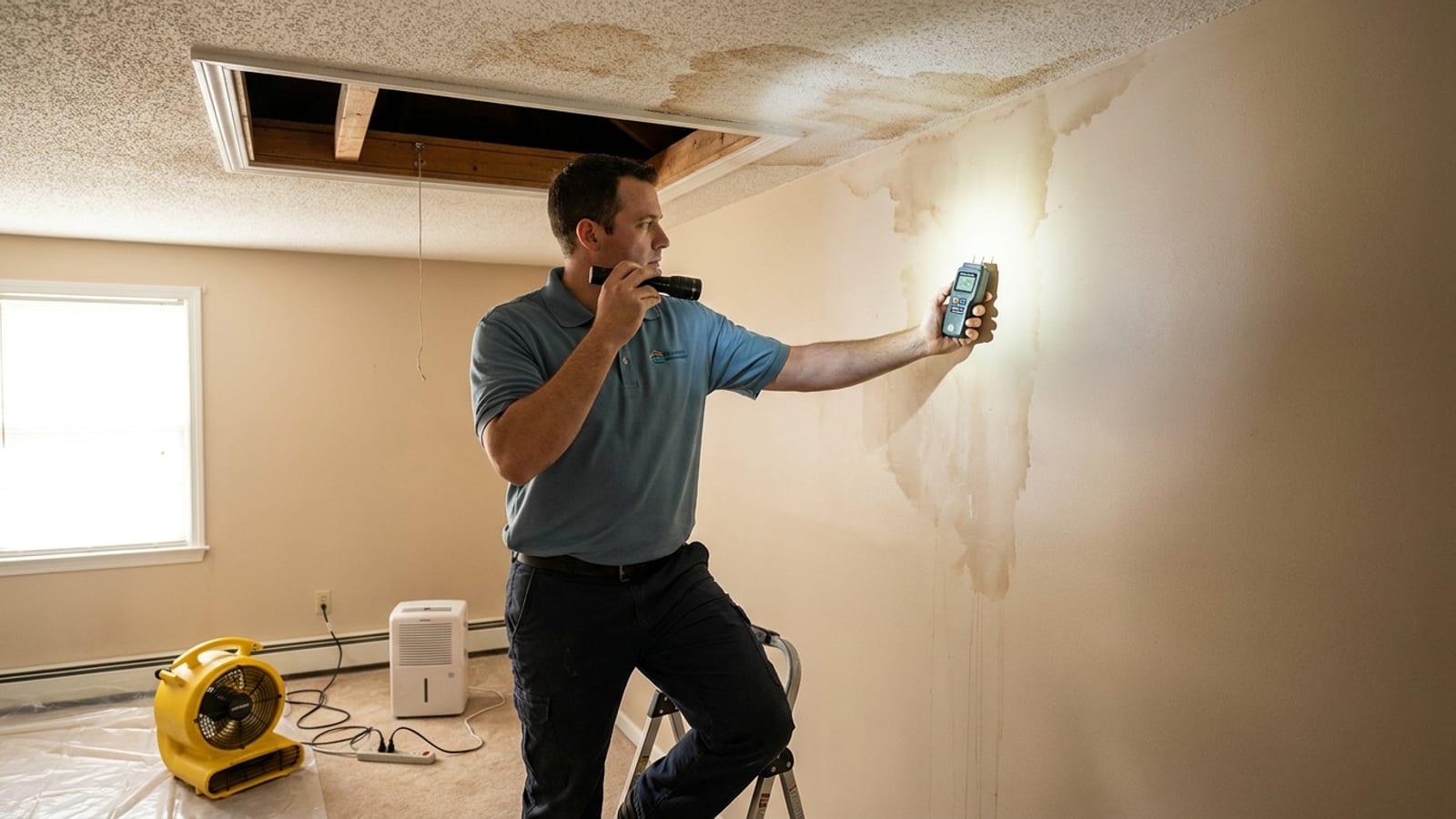
You noticed a stain on the ceiling. Maybe a bulge in the drywall, or water dripping from the light fixture during last night’s rain. A roof leak feels like a roofing problem, but by the time water shows up inside your home, it’s already a water damage problem too. The two issues need to be handled in parallel, and understanding how they connect will save you from a repair job that costs twice as much six months from now.

Why San Diego roof leaks catch homeowners off guard

San Diego goes months without meaningful rain. That long dry spell is actually part of the problem. UV exposure, heat cycling, and marine-layer salt air quietly degrade roofing materials when there’s no rain to reveal the damage. Flashing around chimneys and vent pipes becomes brittle. Tiles shift. Caulk shrinks and cracks. Nothing leaks because nothing tests it.

Then an atmospheric river storm damage event hits, and you get three inches in 24 hours instead of the usual slow drizzle. Suddenly every compromised joint and worn tile is under pressure it hasn’t seen in years. Water finds paths that weren’t obvious in the fall, and it finds them fast.

Older neighborhoods in Encinitas, La Mesa, and parts of El Cajon have a high proportion of homes built in the 1960s and 70s with original tile or composition roofs. Some of those roofs have had repairs layered on top of repairs. When an atmospheric river hits, it’s often the oldest compromised area that fails first, and the failure point is rarely directly above where the water shows up inside.

How roof-leak water travels through your home

This is the part homeowners find surprising. Water does not fall straight down through your house like rain falls through the sky. Once it gets past the roof membrane, it follows the path of least resistance, and that path is almost always horizontal before it’s vertical.

Here’s the typical route. Water enters through a cracked tile, failed flashing, or an open seam. It lands on the roof decking (the plywood beneath your shingles) and begins spreading outward. It runs along the top of ceiling joists or rafters, sometimes traveling six to ten feet from the entry point before finding a gap to drip through. That’s why the water stain on your ceiling is almost never directly below the roof breach.

From the ceiling drywall, water continues down. Interior walls act as channels. Stud bays fill from the top, wicking into the wood framing and soaking insulation. In a two-story home, water can travel from an upstairs ceiling into a first-floor wall before it ever shows up as a visible stain. We regularly find saturated bottom plates and subfloor material in rooms that have no visible ceiling damage at all.

This travel path is why ceiling water damage almost always involves more than just the ceiling. The stain you see is the last stop on a longer journey.

What happens inside the wall cavity

Once water gets into a wall, it’s dealing with materials that are designed to hold structure, not shed moisture. Insulation, whether fiberglass batts or blown-in cellulose, absorbs water and holds it. A wet batt doesn’t dry on its own in a closed wall cavity. It stays wet, pressed against the drywall and the wood framing on both sides.

Wood framing absorbs moisture and begins to lose strength. In San Diego’s mild climate, wet framing is also prime territory for mold. The conditions are right, temperatures don’t drop enough in winter to arrest growth, and the IICRC S500 (the industry standard most reputable restoration companies follow) defines 24 to 48 hours as the window before mold growth becomes likely in wet materials.

Wet insulation has to come out. There’s no way to dry it in place effectively. The standard process involves opening the wall, removing the saturated insulation, drying the framing cavity with directed airflow, confirming moisture readings are back to baseline, and then reinstalling new insulation and patching the drywall. It adds time and cost to the job, but leaving wet insulation in a wall is how a roof leak repair turns into a mold remediation project two years later.

The attic: what we look for first

Before we worry about the ceiling and walls, we go into the attic. The attic tells the whole story. You can usually see water staining on the decking and rafters that traces back toward the actual entry point. We’re looking at how far the moisture has traveled, whether the decking shows signs of delamination (a sign of repeated wetting and drying), whether any insulation on the attic floor is saturated, and whether there’s any visible mold beginning to form on the framing.

Thermal imaging cameras are useful here. They detect temperature differences caused by wet material even when surfaces look dry. We can map the moisture spread across the ceiling plane without tearing open every inch of drywall.

If the attic insulation is blown-in cellulose, it often shows less visible damage than fiberglass but holds more water by weight. We use moisture meters to probe it. If readings are elevated, it needs to come out in the affected area.

Attic drying uses smaller, directed equipment. Air movers push dry air through the space, and dehumidifiers pull the moisture out. We run daily moisture checks and don’t consider the attic dry until readings match the unaffected sections.

Drying the ceiling and walls

Once we’ve mapped the moisture extent, the drying plan covers three zones: attic, ceiling assembly, and any affected wall cavities.

For ceilings, we often drill small access holes between joists to introduce airflow into the joist cavity without removing large sections of drywall. This is less disruptive for the homeowner and preserves materials where possible. If the drywall itself is saturated and has started to sag or crumble, it has to come down. Saturated drywall won’t dry back to a usable state.

Walls require a judgment call based on moisture meter readings. If the framing behind the drywall reads elevated but the insulation hasn’t fully soaked, we can sometimes dry through the wall surface using a specialized wall cavity drying system that injects dry air directly into the stud bay. If insulation is fully saturated, we open the wall, remove it, dry the cavity, and close it back up.

Air movers and commercial dehumidifiers run continuously throughout this process. In a San Diego coastal home, where ambient humidity can run higher than inland areas, dehumidification capacity matters. We size equipment to the job, not to the minimum that might work.

Ceiling water stains are often the last thing we address. The stain itself is cosmetic, but we won’t paint or patch until the underlying moisture readings confirm the structure behind it is fully dry. Painting over a still-damp ceiling traps moisture and guarantees a return call.

Coordinating the roofer and the restoration team

This part is worth being direct about. The roofer fixes the source. The restoration company handles the water damage. Both need to happen, and the order matters.

Get a roofer out immediately to assess the breach and, if possible, apply a temporary tarp or sealant to stop active infiltration. This limits how much additional water enters during the drying process. You don’t need the permanent repair done first, but you do need the active leak stopped or slowed.

We can work alongside a roofer on the timeline. While they’re planning the repair, we’re mapping the moisture, extracting standing water from any ceiling cavities that have pooled, and beginning the drying process. Getting started quickly matters because every additional day of moisture contact increases the risk to framing and the likelihood of mold.

For storm damage restoration caused by atmospheric river events, many San Diego homeowners are dealing with both a roofer and a restoration company for the first time. A few things help: document everything before any work begins (photos and video of every affected area), notify your insurance company early, and make sure both contractors understand what the other is doing so there are no conflicts over sequence or scope.

Insurance coverage for roof-leak water damage depends heavily on the cause. Sudden storm damage is typically covered. Long-term wear that allowed water in may not be. A restoration company can help document that the damage was event-driven, which is relevant to your claim.

When to call us

If you’re seeing ceiling staining, bubbling paint, or water coming through a light fixture after rain, don’t wait for the ceiling to fail. The water is already moving. The sooner we assess the extent of the spread, the better the chances of drying in place rather than opening walls.

Call us at (858) 925-5546 for a same-day estimate.