You’ve got wet drywall and you’re wondering whether the restoration crew is going to gut your walls or whether they can dry them in place and spare you the mess. It’s a fair question, and the honest answer is that it depends on three things: what kind of water got in, how long the walls have been wet, and how high the water traveled. Get those three factors right, and you can make a smart call. Get them wrong, and you end up with a mold problem six weeks later inside a wall that looked fine on the surface.

The type of water changes everything

Not all water is equal, and that matters more for drywall than for almost any other material in your home.

Clean water, what the industry calls Category 1, comes from supply lines, a fresh-water leak, or an early-stage roof intrusion before it picks up debris. If this is what soaked your walls and you caught it within 24 to 48 hours, there’s a real chance the drywall can be dried in place without cutting it out.

Gray water, Category 2, comes from washing machines, dishwashers, or an aquarium overflow. It carries contaminants but isn’t grossly unsanitary. Drying in place is sometimes possible, but the risk profile is higher, and restoration professionals will need to assess whether the contamination level warrants removal.

Black water, Category 3, is sewage, floodwater from a storm surge, or any water that’s traveled through a contaminated source. If black water has touched your drywall, there’s no argument here. It goes. The IICRC S500, the standard most reputable restoration companies follow, is clear on this. Drywall saturated with Category 3 water is a biohazard. Drying it in place traps the contamination inside the wall cavity.

How long it’s been wet is the second factor

Drywall is made of a gypsum core sandwiched between paper facing. The paper facing absorbs water fast. The gypsum core absorbs water more slowly but holds it stubbornly once it’s in there.

In the first 24 hours, even heavily saturated drywall may still be salvageable if the water category is clean and the moisture hasn’t traveled far. After 48 hours, mold becomes a real risk. San Diego’s coastal humidity doesn’t help. Marine layer keeps indoor relative humidity elevated along the coast from Oceanside down through Encinitas, and that ambient moisture gives any remaining water less room to evaporate on its own. In that environment, wet drywall that sits more than two days without active drying equipment running is a mold risk.

After 72 hours or more of saturation, replacement is almost always the right call, regardless of water category. The paper facing breaks down, the gypsum starts to crumble at the surface, and even if you dry it out completely, the structural integrity of the panel is compromised.

Reading the signs: swelling, sagging, and separation

You don’t always need a moisture meter to know when drywall has crossed the point of no return. Your eyes can tell you a lot.

Sagging or bowing means the gypsum core has absorbed so much water that it’s losing rigidity. That panel isn’t going to firm back up when it dries. It’ll stay bowed and will likely crack along the tape seams.

Bubbling or peeling paint means moisture has gotten between the paper facing and the paint layer. Again, this can dry out, but the cosmetic repair is extensive enough that you’re often better off replacing the panel and starting clean.

Soft spots you can feel when pressing on the wall indicate that the gypsum itself has started to break down. Press gently with your fingertip. If the surface gives like wet cardboard, it’s gone.

Visible mold or a musty smell means the call is already made. Mold doesn’t live only on the surface of drywall. By the time you can see it or smell it, it’s almost certainly inside the wall cavity too, and that problem requires removal and treatment, not drying in place.

The flood cut: what it is and when it happens

If you’ve seen a water damage job in progress, you may have noticed walls cut horizontally at about 12 inches, 18 inches, or sometimes as high as 4 feet off the floor. That’s called a flood cut, and it’s one of the most practical tools in restoration work.

The logic behind it is simple. Water wicks upward through drywall by capillary action. The bottom of the wall can be soaked, while the area 18 inches up looks dry to the naked eye. A moisture meter tells the real story. Restorers measure the moisture content at multiple heights and cut above the highest point of detectable saturation, then remove the wet section. The remaining drywall above the cut is dry and stays in place.

For water damage restoration in slab-on-grade homes, which are common throughout San Diego County in neighborhoods like El Cajon, La Mesa, and Chula Vista, flood cuts are often necessary because there’s no crawl space to run air underneath the flooring. All the drying has to happen from above and through wall cavities, and getting the wet drywall out creates the airflow path that equipment needs to work effectively.

After a flood cut, the exposed wall cavity gets inspected for insulation damage, checked for mold, treated if necessary, and then dried with air movers and dehumidifiers before new drywall goes back up.

Drying in place: when it actually works

Drying in place is the right choice when you have clean water, caught it early (under 24 to 48 hours), the drywall is showing no signs of physical breakdown, and you have the right equipment running.

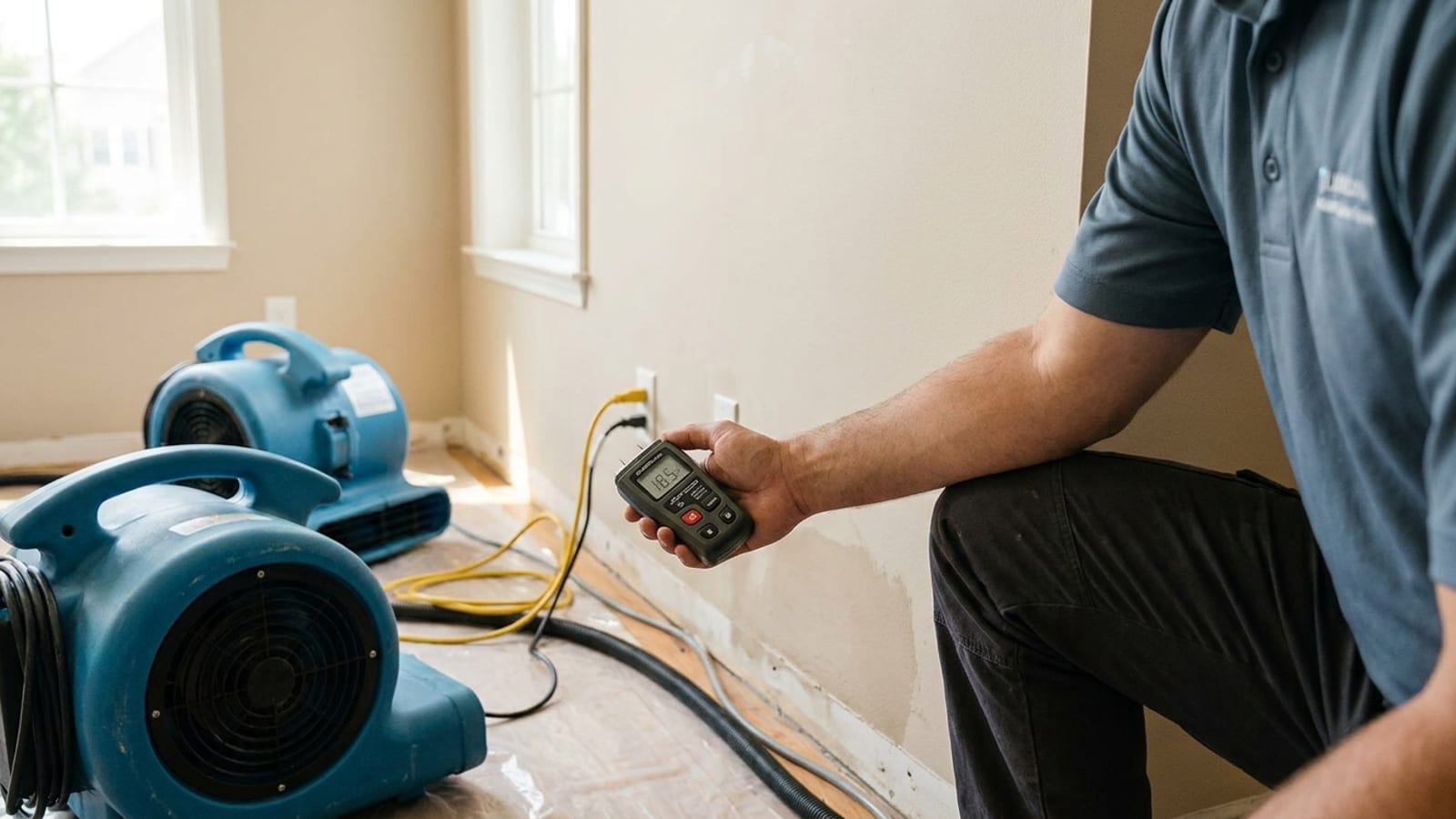
This is not a passive process. You can’t open a window and hope for the best. Effective structural drying means industrial air movers positioned to create airflow across the wet surface, paired with commercial dehumidifiers pulling moisture from the air inside the room. Moisture readings get taken at regular intervals, usually every 12 to 24 hours, to confirm that the material is actually losing moisture rather than just surface-drying while staying wet inside.

Drying in place typically takes three to five days for standard drywall thickness in a well-controlled environment. San Diego’s outdoor humidity can slow that down during a marine layer stretch, which is why professionals track both the moisture content of the materials and the relative humidity inside the space throughout the job. Understanding what is structural drying helps explain why this step matters so much: it’s not just about moving air. It’s about managing the entire environment until materials reach acceptable moisture content.

If moisture readings aren’t trending down consistently after the first day of drying, that’s a sign either the equipment isn’t adequate for the job or there’s a hidden moisture source still feeding the problem.

The hidden moisture problem is the real issue

Here’s what catches people off guard. The drywall surface can register as dry while the wall cavity behind it is still holding significant moisture. This happens because drywall is a decent insulator. Air movers dry the surface faster than the cavity dries, and a basic moisture check at the surface gives a false sense of progress.

A thorough inspection uses a penetrating moisture meter, which measures moisture deep inside the panel rather than just at the face. For walls with vapor barriers, the situation is even more complicated. The barrier traps moisture in the cavity, and surface drying tells you almost nothing about what’s happening behind it.

This is the same dynamic that leads to mold showing up weeks after what seemed like a successful dryout. The wall felt dry, the paint looked fine, and then the musty smell started. By that point, mold has been growing in the wall cavity long enough to spread. Ceiling leaks can create a similar false impression; you can read more about how those play out in our post on ceiling water stains.

Older coastal homes in Encinitas, Oceanside, and Pacific Beach often have original insulation behind the drywall that holds water the way a sponge does. Standard surface drying protocols aren’t enough for those walls. Knowing whether that insulation is saturated, and whether it can be dried or needs to come out along with the drywall, is part of the assessment that happens before any equipment gets set up.

When to call a professional

If the water was clean and you caught it within the first few hours, a dehumidifier and some air circulation might be enough if the affected area is genuinely small. But if you’re not getting consistent moisture readings, if there’s any chance the water sat for more than 24 hours, if you’re dealing with gray or black water, or if you see any of the physical signs described above, this is a job for a restoration professional.

The cost of cutting out and replacing a section of drywall is almost always less than the cost of mold remediation inside a wall that appeared to dry out but didn’t. An honest assessment upfront, with actual moisture data to back it up, is the only way to know which path you’re on.

Call us at (858) 925-5546 for a same-day estimate.