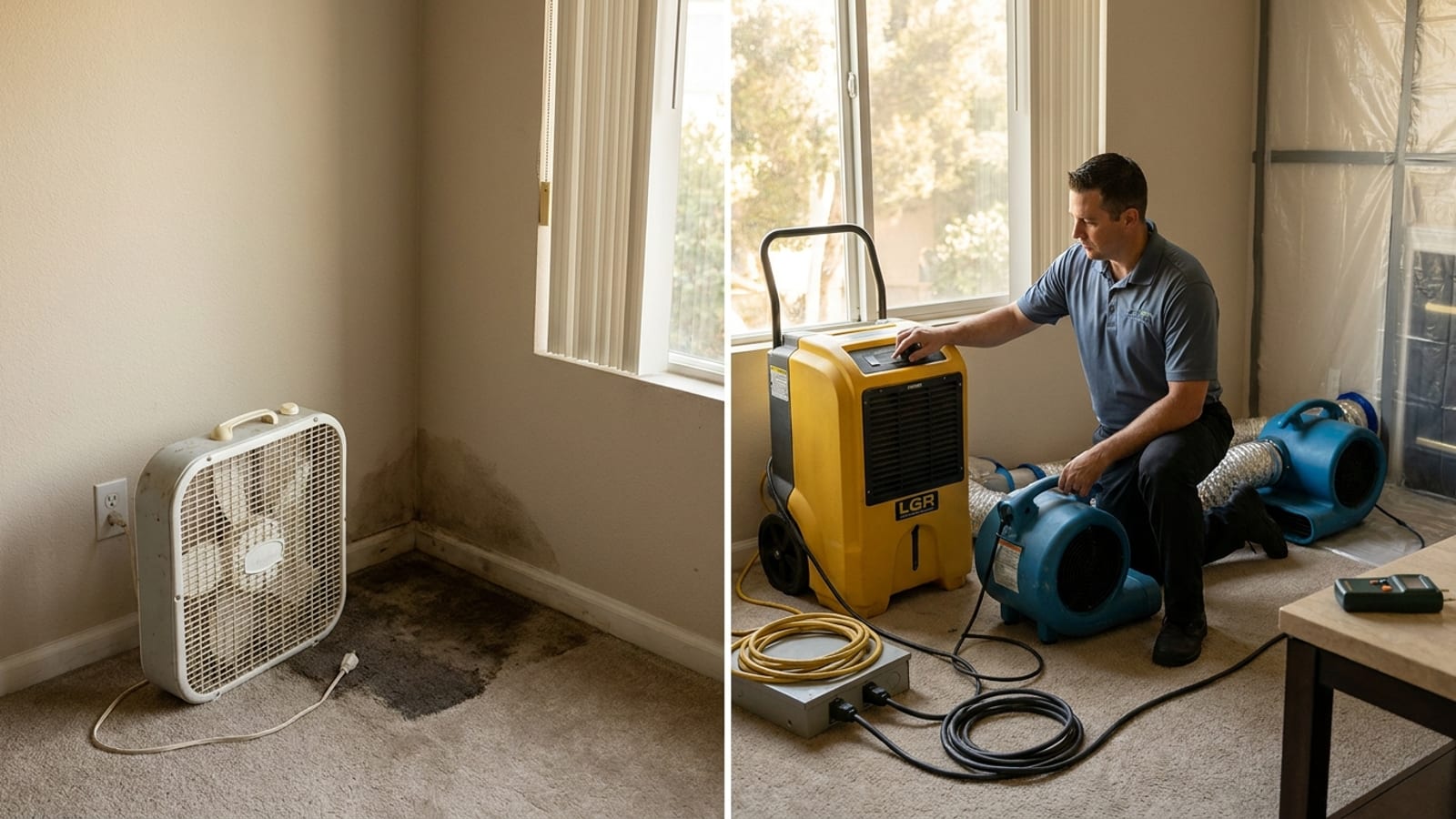
You knocked over a pot of water near the kitchen sink, mopped it up in five minutes, and now you’re wondering whether you need to call someone. Or maybe a supply line let go under the bathroom vanity and you’re staring at soaked tile, a swollen cabinet base, and a wall that’s still warm to the touch. Those two situations are not the same problem. One you can handle yourself. The other, almost certainly, you cannot.
Here’s an honest breakdown of where the line sits, and why getting it wrong costs far more than the call.
When DIY drying is actually fine
A small, clean-water spill caught immediately is genuinely manageable on your own. We’re talking about a glass of water on a hardwood floor you wiped up in under a minute, or a bathroom sink overflow you noticed before it soaked past the tile grout. The keyword in both cases is “immediately.”
If you got to it fast and the water source is clean (no sewage, no dishwasher backflow, no flood water from outside), here’s what works:
Soak up as much liquid as possible first. Towels, a shop vac, whatever you have. Don’t skip straight to fans. Fans accelerate evaporation of surface moisture, but they can’t pull liquid water out of a soaked material. Get the bulk out manually.
Then run air circulation. Two or three fans aimed at the wet surface, windows open if humidity outside is lower than inside. San Diego’s marine layer can work against you here. If the air outside feels heavy and damp (common in coastal neighborhoods like Ocean Beach or Pacific Beach on a June morning), keep the windows closed and run the AC on the dry setting instead.
Give it 24 to 48 hours, then feel the surface and the surrounding areas, including any adjacent baseboards or drywall. If everything is dry to the touch and there’s no musty smell, you’re likely okay.
That’s the upper limit of what makes sense to handle yourself.
Where household fans fail
This is where a lot of homeowners get into trouble. A box fan or a pedestal fan moves air. It does not remove moisture from the air. Dehumidification is an entirely different function, and it’s one of the most important tools in professional drying.
Here’s why it matters. When water soaks into drywall, subfloor sheathing, or wood framing, the material releases that moisture slowly as vapor. If the surrounding air is already humid, that vapor has nowhere to go. The material stays damp. In San Diego’s climate, especially in homes close to the coast or in older stucco construction in neighborhoods like Chula Vista or National City, indoor humidity levels can run high enough that a household fan does almost nothing useful.
Commercial dehumidifiers used in professional restoration can remove dozens of gallons of moisture from the air per day. Your home dehumidifier from a big-box store removes a fraction of that. There’s no comparison in capacity.
This is also why jobs that look simple on the surface often aren’t. The visible water is only part of the problem. The water you can’t see, drawn by capillary action into wall cavities, under flooring, and into subfloor panels, is what causes long-term damage if it’s not removed properly. A contractor who knows what is structural drying will tell you that drying the surface while moisture stays trapped inside the assembly is like putting a bandage over an infection.
The 24 to 48 hour mold window
Mold doesn’t need much. A wet surface, temperatures above 40 degrees (which is every day in San Diego), and 24 to 48 hours is enough for spores to begin colonizing. That window is not a guideline. It’s a hard biological reality.
If you discovered the water damage and it’s been sitting for more than a day, you’re no longer just dealing with a drying problem. You may already have mold beginning to form inside walls, under the flooring, or in the insulation you can’t see.
This changes the scope of work significantly. It also changes the safety picture, especially if anyone in the home has respiratory issues or allergies.
A professional assessment at that point isn’t an upsell. It’s the only way to know what you’re actually dealing with. Restoration technicians use moisture meters to measure the water content inside drywall, subfloor panels, and wood framing. A surface that feels dry to your hand can still read 20, 25, or even 30 percent moisture content, which is well into the range where mold growth accelerates. You can’t determine “dry” by touch. It requires a meter.
Water category matters more than you think
Not all water damage is the same. The industry uses a three-category system to classify how contaminated the water source is, and the category determines how aggressive the cleanup needs to be.
Category 1 is clean water. A supply line, a water heater, a faucet overflow. This is the only category where DIY has any reasonable shot at success, and only if the damage is small and caught immediately.
Category 2 is gray water. This includes dishwasher backflow, washing machine overflow, aquarium leaks, or toilet overflow that contains urine but not feces. Gray water carries bacteria and chemical contaminants. You should not be handling gray water mitigation without appropriate protective equipment and professional-grade sanitizing.
Category 3 is black water. Sewage backup, flood water from outside, or any category 1 or 2 water that has been sitting long enough to grow bacteria. Black water is a biohazard. Full stop.
Here’s the part that surprises people: categories escalate. Clean water that sits for 48 hours in a warm space becomes gray water by contamination. Gray water that sits longer becomes black water. So even if your leak started clean, timing determines what category you’re actually dealing with by the time you start cleanup.
What pros actually measure and why it matters
One of the most common misconceptions about water damage is that “dry enough” is obvious. It’s not.
Restoration professionals follow drying standards that require measuring moisture content in affected materials and tracking those readings daily until everything returns to acceptable baseline levels. The baseline isn’t zero, it’s the normal equilibrium moisture content for that material type in that climate. For San Diego, that’s typically in the range of 10 to 13 percent for wood materials, though it varies.
Getting there requires the right equipment, placed correctly, run long enough. Structural drying isn’t just about setting up fans and walking away. It’s about creating a controlled drying environment: positive airflow, reduced humidity, enough dwell time for moisture to migrate out of dense materials and into the moving air where the dehumidifier can capture it.
A professional will also document those readings over the drying period. That documentation matters for insurance purposes. If your claim involves a significant water loss, your insurer will likely want to see a drying log showing materials reached target moisture levels before reconstruction began.
If you’re trying to figure out how long restoration takes from start to finish, the drying phase alone typically runs three to five days for a contained residential loss, sometimes longer depending on materials and the extent of saturation.
Where DIY stops and professionals start
To put it plainly: the line sits at complexity, not cost.
You can dry a small, clean-water spill caught within minutes. You cannot safely or effectively dry water that has been sitting more than 24 to 48 hours, water that has reached wall cavities or subfloor assemblies, any gray or black water source, or any area larger than a few square feet of flooring or drywall.
In those situations, the equipment gap is too large, the contamination risk is too real, and the hidden-moisture problem is too likely to result in mold if it isn’t addressed with professional tools and moisture verification.
The other factor is documentation. If there’s any chance you’ll file an insurance claim, professional involvement from the start creates the paper trail your insurer needs. Emergency water extraction done by a certified company with documentation of moisture readings and drying logs is a fundamentally different claim submission than “I ran some fans for a few days.”
When to call
If you’re reading this while standing in a wet room trying to decide, here’s the short version. If the source is clean water, the area is small, and you caught it within minutes, try DIY first and reassess in 24 hours. If there’s any doubt about how long the water has been sitting, if the affected area includes walls or subfloor, if the source isn’t clean water, or if you’re smelling anything musty, call a professional.
The cost of getting it wrong is mold remediation, structural repair, or both. That’s a much larger problem than the cost of a professional assessment.
Call us at (858) 925-5546 for a same-day estimate.