You cleaned up the water days ago. The floor looks dry. The towels are gone. But there’s still that smell, earthy and stale, drifting out from somewhere you can’t quite pin down. That smell isn’t a minor annoyance. It’s your home telling you the job isn’t done, and something hidden is still wet.

What that smell actually is

The musty odor that follows water damage has a specific name in the industry: microbial volatile organic compounds, or MVOCs. Mold and bacteria release these gases as they break down wet organic material, things like drywall paper, wood framing, and subfloor sheathing. The smell is a byproduct of active microbial growth, which means by the time you’re noticing it, the process is already underway.

Mold can begin colonizing within 24 to 48 hours of water exposure. San Diego’s coastal humidity doesn’t help. The marine layer keeps indoor relative humidity elevated, especially in older homes near the coast in Encinitas, Oceanside, or Pacific Beach. What might dry out quickly in a drier climate lingers here, giving mold exactly the window it needs.

The important thing to understand is that the smell isn’t coming from leftover dampness on a surface. It’s coming from moisture that’s trapped inside a structural assembly, a wall cavity, a subfloor, or a layer of insulation, where it can’t evaporate on its own. Surfaces can feel bone dry to the touch while the framing behind them holds 30 to 40 percent moisture content. That’s enough to keep mold growing for weeks.

Why masking the smell doesn’t work

Plug-in air fresheners, candles, and spray deodorizers cover a smell for a few hours. They do nothing about the source. The mold keeps growing, the MVOCs keep off-gassing, and the odor comes back, usually stronger.

Some homeowners try ozone generators or foggers, thinking a heavy-duty treatment will neutralize the smell. These products can reduce surface odors temporarily, but they don’t penetrate wall cavities or wet insulation where the growth is actually happening. You can’t sanitize something you haven’t dried first.

The only real fix is removing the moisture. Once the wet material dries completely and the microbial activity stops, the odor goes away. There’s no shortcut to that. The question is how to find where the moisture is hiding.

How pros trace the source

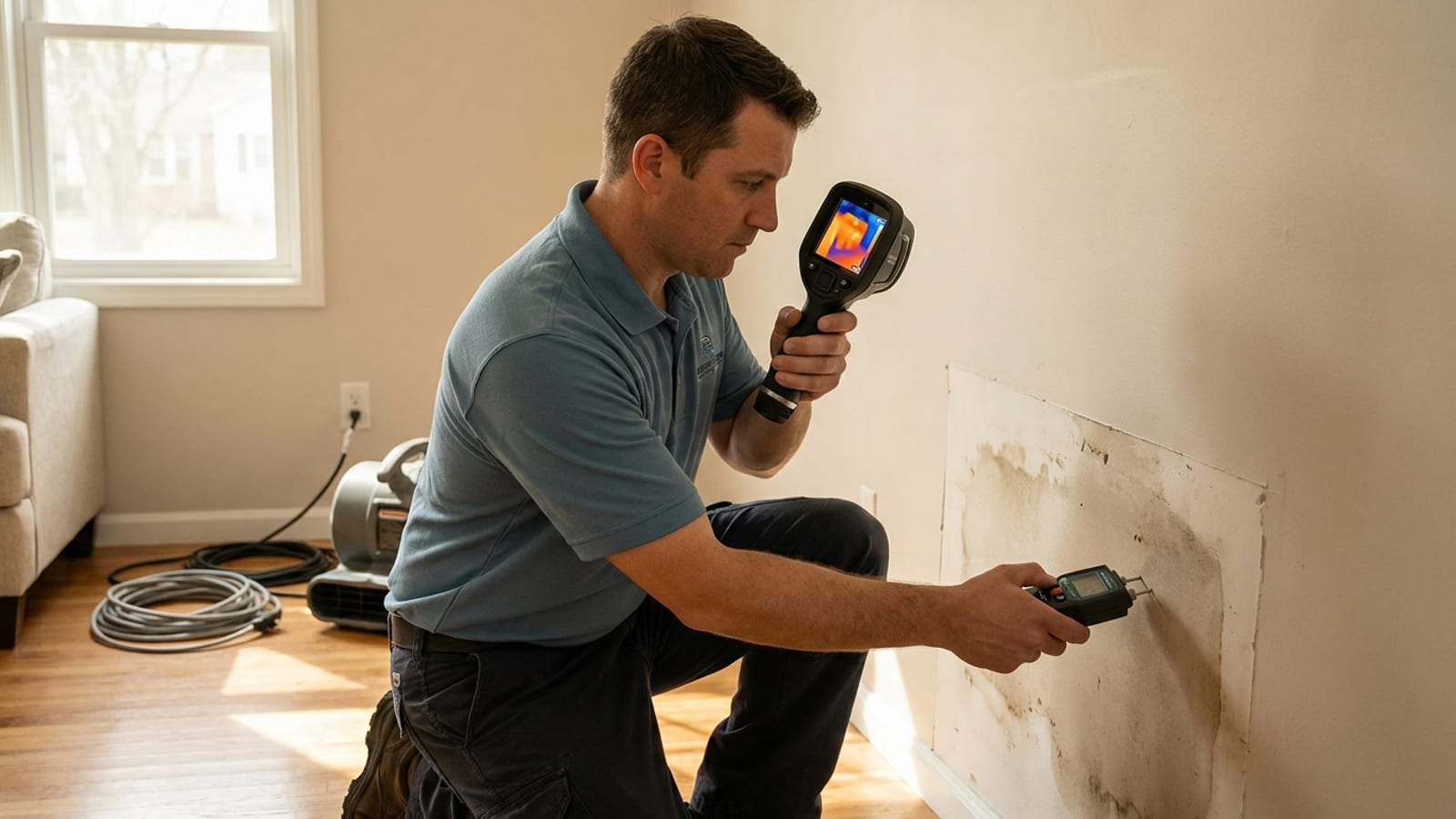
This is where the detective work happens. A moisture reading from the surface tells you almost nothing if you haven’t also checked behind it. Restoration technicians use two main tools to find hidden moisture.

Moisture meters come in two types: pin meters and non-invasive (pin-less) meters. Pin meters measure resistance between two probes pressed into the material, giving an accurate reading of moisture content at that specific point. Pin-less meters use radio frequency to detect moisture deeper in a wall assembly without penetrating the surface. A technician will scan a grid across the affected area, checking readings at multiple depths, to map where moisture concentrations are highest and how far they’ve migrated.

Thermal imaging cameras show temperature variation across surfaces. Wet materials hold temperature differently than dry ones. When a wall cavity holds standing water or saturated insulation, the surface in front of it will often show a distinctive cool pattern on the thermal image, even when it looks and feels dry to the touch. Thermal imaging is especially useful for tracking water migration paths, seeing how far water traveled from the original leak source through wall assemblies, across subfloors, or along framing.

Together, these tools let a technician build an actual map of the moisture problem. That map determines what needs to come apart, what can be dried in place, and where drying equipment needs to go.

In slab-on-grade homes common throughout San Diego County, like the ranch-style builds in El Cajon and Santee, water from a slab leak or a washing machine overflow can migrate under the flooring for 10 or 15 feet before pooling somewhere visible. The smell might be coming from a wall 12 feet from where the leak happened. Without moisture mapping, you’d never find it.

What structural drying actually involves

Once the source is located, the work is drying the structure, not just the air in the room. This is called structural drying, and it’s meaningfully different from running a box fan and hoping for the best.

Professional drying uses a combination of high-velocity air movers and commercial dehumidifiers calibrated to the size and moisture load of the affected space. Air movers are positioned to create a circular airflow pattern across wet surfaces, pulling moisture out of materials through evaporation. The dehumidifiers capture that moisture from the air and remove it from the space. Running one without the other doesn’t work well. Air movers without dehumidification just push humid air around. Dehumidification without airflow can’t pull moisture fast enough from saturated materials.

For wall cavities, technicians often drill small holes at the base of the wall and insert directional nozzles to force dry air directly into the cavity. This is far more effective than trying to dry the cavity through the intact wall surface. The holes are small and easy to patch, and they make the difference between a wall that dries in three days versus one that stays wet for weeks.

Drying is monitored daily. Moisture readings are logged at each location, and equipment is adjusted as readings drop. The standard most reputable restoration companies follow, the IICRC S500, defines specific drying goals for different material types. Drywall, wood framing, and concrete all have different acceptable moisture content thresholds. The job isn’t done until every affected material reaches those targets, verified by the meter readings.

Skipping to reconstruction before those numbers are hit is where a lot of problems start. Putting new drywall over a wall cavity that’s still at 25 percent moisture content means the mold problem just gets sealed in.

When mold is already present

If the smell is strong or has been present for more than a few days, there’s a good chance visible mold growth exists somewhere in the assembly, even if you can’t see it yet. Understanding will water damage grow mold is straightforward: yes, reliably, if moisture isn’t removed quickly. The conditions after a leak are almost ideal for it.

Mold remediation is a separate process from drying, though they often happen together. Contaminated materials (drywall, insulation, sometimes framing) need to be removed, the area treated with an EPA-registered antimicrobial, and the space allowed to dry before reconstruction. Mold remediation done properly involves containment to prevent spores from spreading to unaffected areas, air scrubbers with HEPA filtration to capture airborne spores, and clearance testing after the work is complete.

If you’re not sure whether you’re dealing with a drying problem or a mold problem, a mold inspection can answer that question before you commit to a remediation scope. Testing can confirm whether mold is present, identify the species, and establish a baseline so you can verify the remediation worked.

One thing worth knowing: older homes in coastal San Diego, particularly those with original stucco and wood-frame walls, are more vulnerable to mold establishing quickly after a leak. The porous stucco, combined with wood lathe or older drywall systems, holds moisture in ways that modern construction handles better. If your home is from the 1960s or 1970s and you’re noticing a musty smell after any water intrusion, don’t wait to have it checked.

How long does the smell last after proper drying?

This is a reasonable question and the honest answer is: it depends on how much mold was present and how completely it was removed.

If the structure was dried before significant mold growth established, the MVOC smell typically fades within a week or two of the drying being complete. The microbial activity stops, no new gases are produced, and the residual odor dissipates.

If mold was already actively growing, the smell won’t fully clear until the contaminated material is removed and the area is treated. Drying alone won’t eliminate the odor if the mold colony is already established. That’s a remediation job.

In either case, using an air purifier with a true HEPA filter and activated carbon can help manage odor during and after the work. Activated carbon absorbs VOCs, which helps noticeably. But it’s a support measure, not a replacement for addressing the underlying moisture.

When to call a professional

If you’re noticing a musty smell after a leak or flood and you can’t confidently confirm that the structure dried completely within 48 to 72 hours of the water event, it’s time to have a professional assess it. The same applies if the smell persists more than a few days after you thought everything was dry, if you see any discoloration on walls or ceilings, or if anyone in the home is having respiratory symptoms.

Moisture meters and thermal cameras aren’t consumer tools. The moisture mapping step is where most DIY attempts fall short, and it’s the step that determines whether the problem gets solved or just delayed.

Call us at (858) 925-5546 for a same-day estimate.