You went to switch the laundry and found an inch of water on the laundry room floor. Or maybe you heard nothing at all and only discovered the damage hours later, when a wet streak had already crept under the baseboard and into the hallway. Either way, a washing machine leak or overflow is one of the more common appliance disasters we see in San Diego homes, and it can do a lot more damage than it looks.

Here’s what’s actually happening behind your walls, what to do right now, and how to make sure the drying gets done properly so you’re not dealing with mold or buckled floors three weeks from now.

The most common reasons washing machines leak

Most washing machine leaks trace back to one of three things: a burst supply hose, a drain line backup, or a failed door seal. Front-load machines in particular see a lot of door gasket failures, where the rubber seal cracks or collects debris and stops forming a watertight ring. When that happens, water pours out the front every cycle.

Supply hoses are the other big culprit. The standard rubber hoses that come with most machines have a lifespan of about five years, and in older homes in El Cajon, La Mesa, or North Park, those hoses sometimes haven’t been touched in a decade. They can fail slowly with a pinhole drip, or they can let go all at once. A burst supply hose at full pressure can dump several gallons per minute onto your floor.

Drain line backups happen when the hose that carries water out of the machine gets kinked, clogged, or improperly seated in the standpipe. Instead of draining, the machine overflows from the top. If you’ve ever run a full cycle only to find a wide, shallow puddle spreading out from under the machine, this is usually why.

Overfilling from a faulty water inlet valve is less common but worth mentioning. When the valve sticks open, the machine keeps filling past the drum’s capacity. The result is a slow-motion overflow that can run unnoticed for most of a cycle.

How fast water moves, and where it goes

The part that catches people off guard is the speed. Water from a washing machine leak doesn’t stay politely in the laundry room. It follows the path of least resistance, which in most slab-on-grade homes across San Diego County means it spreads under baseboards, seeps through the grout lines in tile, and travels horizontally along the subfloor or concrete slab well beyond the visible wet area.

In homes with hardwood or laminate flooring adjacent to the laundry room, that water gets underneath within minutes. Engineered wood starts to swell and cup. Laminate begins to delaminate. If there’s carpet, the pad beneath it absorbs water like a sponge, holding moisture long after the surface feels dry to the touch. We cover what that actually means for your flooring in more detail in this post about water-damaged carpet.

Walls are the other concern. If the laundry room shares a wall with another room, or if the machine sits in an interior closet, water can wick up into drywall from the base. Drywall is extremely porous. A baseboard that got wet for two hours can leave the drywall above it saturated six inches up, even if you can’t see or feel it from the surface. That hidden moisture is exactly where mold starts.

In two-story homes, the stakes are even higher. Water from a second-floor laundry can penetrate through the subfloor into the ceiling below, soaking insulation and ceiling drywall before it ever shows up as a visible stain.

What to do in the first hour

First priority: stop the water source. Behind every washing machine there are two supply valves, one for hot and one for cold. Turn both clockwise until they stop. If the valves are corroded or won’t budge, go to your home’s main water shutoff instead. Don’t let the machine finish its cycle hoping the water will drain on its own.

If the machine is still running, turn it off. Unplug it if you can do so safely, meaning you’re not standing in water to reach the outlet. If there’s standing water near any electrical outlets or the outlet the machine is plugged into, don’t touch anything electrical. Get a professional involved.

Once the water source is cut off, remove as much standing water as you can. Towels and mops work for small amounts, but a wet-dry shop vac is much more effective. The goal isn’t to get it perfect; it’s to reduce the volume of water that continues soaking into materials while you figure out next steps.

Move anything off the wet floor that doesn’t need to be there: rugs, storage boxes, anything fabric or paper. Open cabinet doors nearby to let air circulate. If you have a fan, point it at the wet area.

Document everything before you start cleaning. Photos and short videos of the standing water, the machine, the hoses, and any visible damage are important for insurance purposes. The distinction between a “sudden and accidental” leak (typically covered) and a slow drip that was ignored over time (often not covered) matters a lot when you file a claim.

Why the drying process matters more than the cleanup

Getting the visible water off the floor is the easy part. The hard part is drying the materials that absorbed it. Most homeowners underestimate this step, and it’s where the real damage compounds.

Concrete slabs in San Diego homes hold moisture longer than most people expect, especially given the marine-layer humidity along the coast. Drywall, subfloor sheeting, and wood baseboards all have moisture contents that need to come down to normal levels before reconstruction or flooring replacement can happen. If materials stay wet long enough, mold can begin forming within 24 to 48 hours.

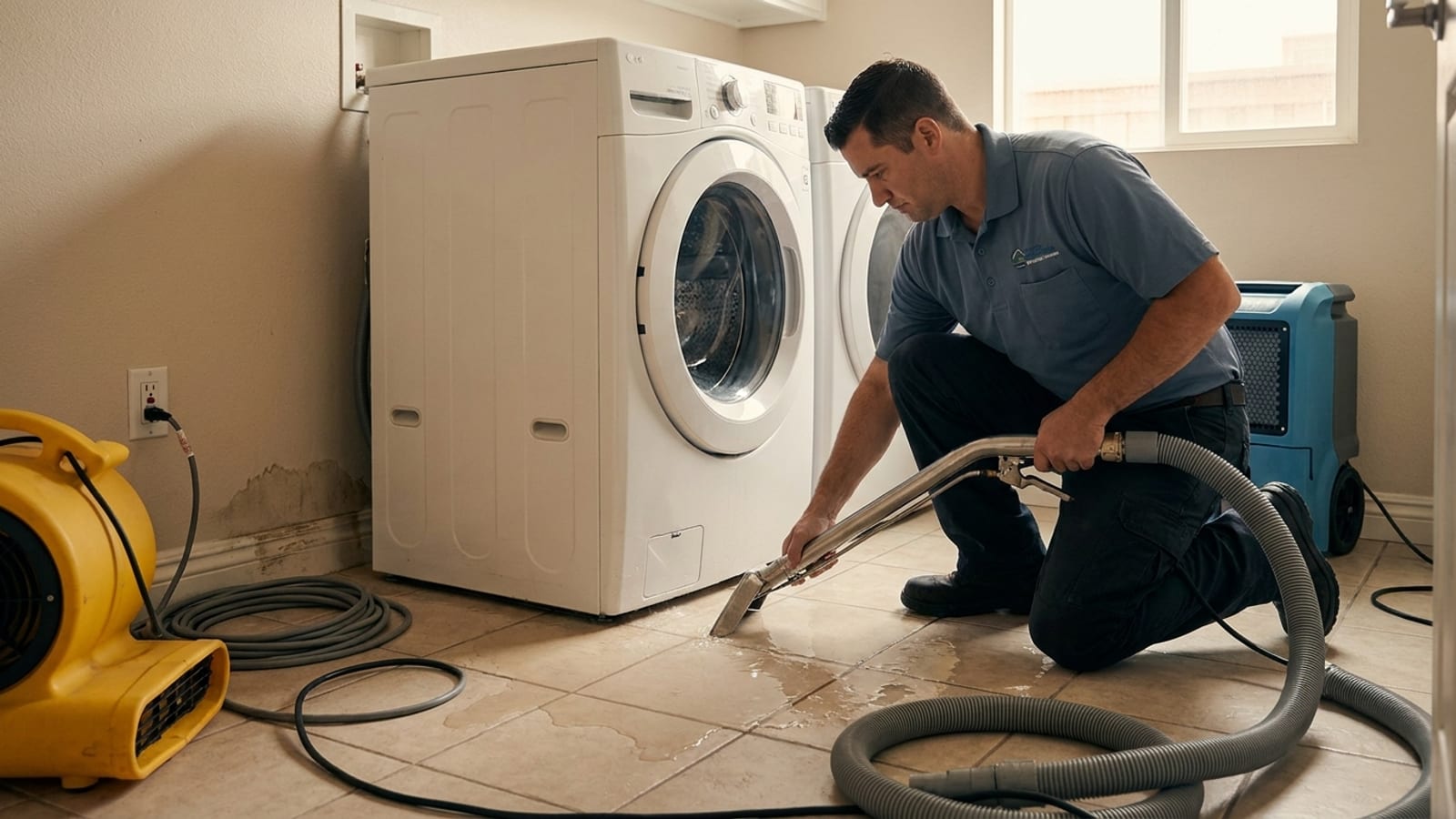
Professional restoration uses a combination of high-velocity air movers and commercial dehumidifiers to pull moisture out of materials systematically. The equipment is sized to the job and placed based on where moisture meters show elevated readings, not just where the floor looks wet. Thermal imaging cameras often reveal saturation patterns that aren’t visible to the eye at all.

This is why emergency water extraction is about more than just vacuuming water off the floor. Extraction equipment pulls moisture from carpet, padding, and sometimes even from the top layer of concrete or subfloor. The faster you remove that water from materials, the shorter the drying time and the lower the risk of mold.

A full structural dry typically takes three to five days with professional equipment running continuously. Moisture readings are checked daily, and equipment is adjusted or moved as materials dry out. That systematic approach is what separates a proper restoration from a cleanup that leaves hidden moisture behind.

The mold window is shorter than you think

Forty-eight hours is the benchmark you’ll hear from any reputable restoration company, and it’s based on real microbial science. Given the right conditions (moisture, organic material, moderate temperatures), common household mold species can establish colonies within that window.

San Diego’s climate creates a challenging environment. Coastal neighborhoods like Oceanside, Encinitas, and Chula Vista deal with elevated ambient humidity that slows natural evaporation. A laundry room that might dry on its own in Phoenix could hold enough moisture in San Diego to cross that 48-hour threshold.

If mold does establish in drywall or wood framing, drying alone isn’t enough. Remediation requires containment, antimicrobial treatment, and in some cases removal of affected materials. That process costs significantly more than addressing the water damage promptly in the first place.

This same risk applies to any appliance leak in the kitchen or utility areas. If you’ve dealt with a similar situation at a different fixture, the post on dishwasher leak water damage covers the same principles for that scenario.

What professional water damage restoration looks like

Water damage restoration after a washing machine leak follows a structured process built around the IICRC S500, the standard most reputable restoration companies follow for water damage mitigation.

It starts with a moisture inspection to map every affected area, not just the laundry room. Technicians probe walls, check baseboards, and scan the subfloor to understand where water traveled. That inspection determines the scope of the job.

Extraction comes next, removing standing water and pulling moisture from saturated materials. Then drying equipment is deployed, typically multiple air movers and a commercial dehumidifier sized to the square footage and moisture load. Daily monitoring tracks progress.

If flooring needs to come up to allow the subfloor to dry, that happens during the drying phase. Baseboards may be removed for the same reason. Once moisture readings confirm everything is back to normal levels, reconstruction can begin.

The cost varies depending on how far the water traveled, how long it sat before being addressed, and what materials were affected. A laundry room flood caught within an hour looks very different from one that ran for three hours into adjacent rooms. Acting fast is the most direct way to keep the scope of work, and the cost, manageable.

When to call us

If a washing machine leak or overflow got into more than a small, contained area, or if you’re not sure how far the water spread, it’s worth getting a professional assessment. We can tell you exactly what’s wet, what the risk level is, and what drying will actually take. You don’t want to guess on this one and find out two weeks later that you missed something.

Call us at (858) 925-5546 for a same-day estimate.