The surface dried out two days ago. The carpet feels almost normal, and the laminate looks fine. But there’s a soft spot near the refrigerator, a new squeak by the bathroom door, and a smell you can’t quite place. That smell is the subfloor telling you something the surface never showed.
Wet subfloor damage is one of the most common things we find in San Diego homes after a water event, and one of the most underestimated. The plywood or OSB beneath your flooring absorbs water fast, dries slowly, and causes serious structural and air quality problems if it’s not addressed properly. Here’s what’s actually happening under your feet.
How water gets into the subfloor
The subfloor is the structural layer of wood (usually 3/4-inch plywood or OSB) that sits on top of your floor joists and under your finish flooring. Water reaches it in a few ways.
The most obvious is an overflow: a dishwasher door left open, a washing machine that ran over, a toilet that backed up. Any significant volume of water on the floor will find the seams and edges of your finish flooring and wick down. Vinyl plank and tile can actually trap water underneath them, holding it against the subfloor longer than an open floor would.
Appliance leaks are another common culprit in San Diego homes. A refrigerator’s ice maker line, a dishwasher supply hose, a washing machine drain that’s slowly been dripping at the connection. These leaks often go unnoticed for weeks. By the time the homeowner in El Cajon or Chula Vista finds the soft spot, the subfloor has been saturated repeatedly and may already be delaminating.
Slab leaks are a bigger problem in older San Diego neighborhoods with slab-on-grade construction. When a pipe fails under the concrete, water wicks up through the slab and into the subfloor from below. There’s no visible puddle. The first sign is often a warm spot on the floor, a water bill that jumped, or a soft patch that seems to have no explanation. This type of moisture migration is slow and continuous, and it can affect large areas before it’s detected.
Finally, moisture intrusion from below. In areas near the coast like Oceanside or Encinitas, under-floor crawl spaces with poor vapor barrier coverage can allow ground moisture and marine-layer humidity to saturate floor joists and the subfloor over time, especially in older homes.
What a wet subfloor feels and smells like
You may not see anything wrong, but you’ll feel it and smell it. A healthy subfloor is solid underfoot. A saturated one gives slightly when you walk on it, especially near the edges of a room or in the center of a span between joists. Some homeowners describe it as a subtle trampoline effect, or a feeling that the floor moves a little more than it should.
Squeaks are another sign. Wood that swells from moisture presses against fasteners and adjacent boards in new ways. If your floor started squeaking after a water event, that’s not settling. That’s movement caused by swollen, weakened wood.
Cupping is common with hardwood flooring over a wet subfloor. The edges of each board rise higher than the center because the underside of the wood is absorbing moisture faster than the top surface. It looks like a very subtle washboard across the floor. If you’re seeing this, the subfloor below is almost certainly wet too. (We go deeper into the decision of whether to save or replace the finish flooring in our post on water damaged hardwood floor save or replace.)
The smell is distinct. Wet wood has an earthy, musty odor that’s different from normal house smells. If mold has started, it’s more pungent, like a damp basement. In San Diego’s warm temperatures, mold can begin colonizing wood surfaces within 24 to 48 hours of saturation, so the smell can show up quickly.
Why surface drying isn’t enough
This is the part that trips a lot of homeowners up. You run fans, maybe a dehumidifier from the hardware store. The carpet pad gets pulled, the surface dries out. You check the floor with your hand and it feels dry. So you assume it’s handled.
But finish flooring acts as a vapor barrier. Tile, vinyl plank, and laminate all trap moisture beneath them. Air movers sitting on top of the floor move air over the surface, not through the layers. The subfloor, with no path to the air above it, stays wet while everything above it dries out.
OSB is particularly vulnerable. It absorbs water faster than plywood and degrades faster when saturated. The glued wood fibers swell, and once OSB has swollen badly, it doesn’t return to its original dimensions when it dries. It stays uneven, weak, and prone to delamination. Plywood holds up better but still warps under prolonged moisture exposure, especially at edges where it meets the walls or joins another panel.
Floor joists can take on moisture too. If a joist is holding a wet subfloor for several days, the wood swells, and if there’s any existing checking or cracks in the wood, moisture works deeper. In older San Diego homes where joists might be decades old, this is a faster path to structural compromise than in newer construction.
The only way to dry a wet subfloor effectively is to either remove the finish flooring so the surface is exposed, or use specialty drying equipment that forces air through the assembly from beneath.
How professionals actually dry a subfloor
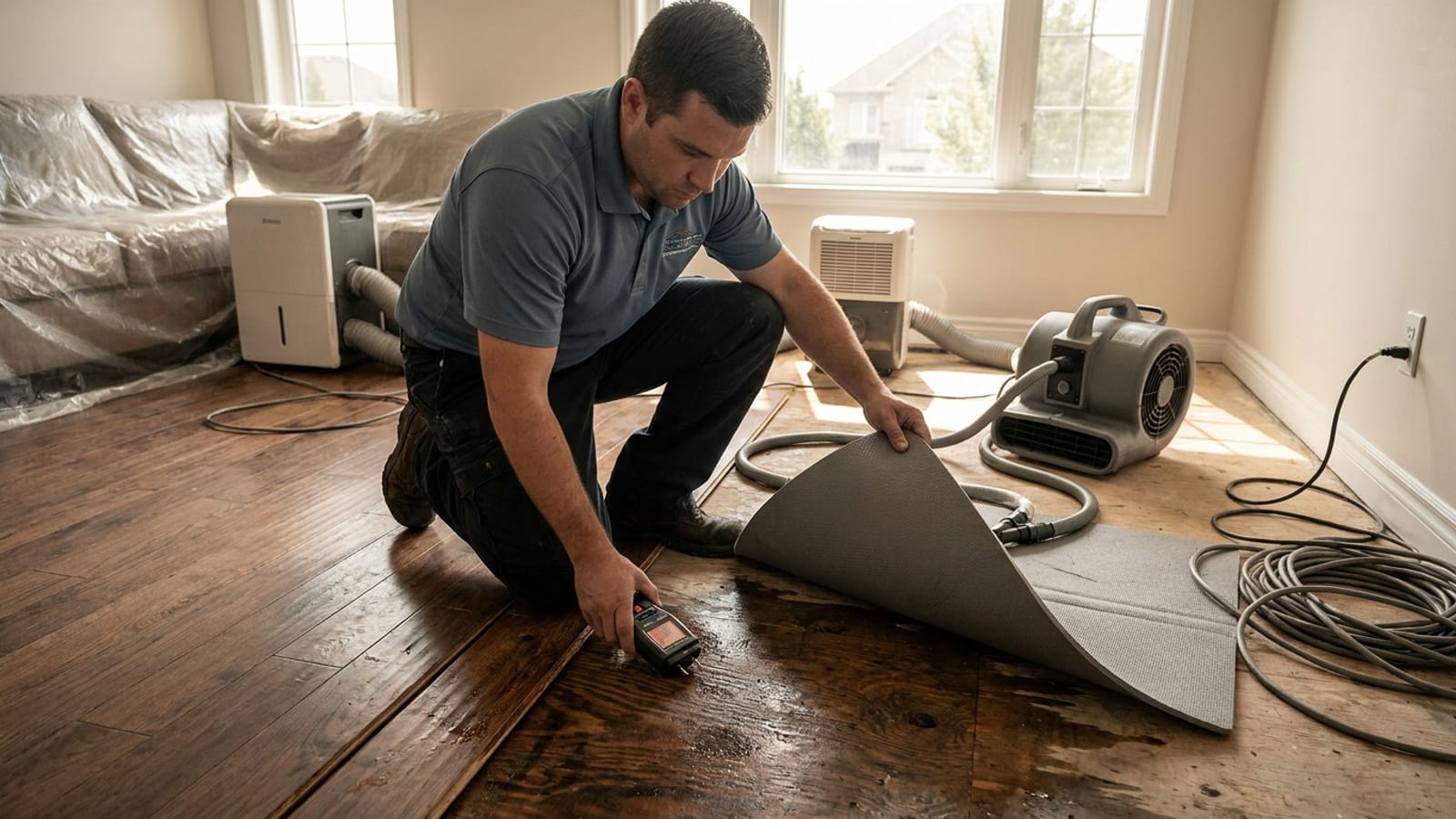
The standard approach in water damage restoration for subfloor drying starts with moisture mapping. A technician uses a pin-type moisture meter to probe the subfloor through the finish flooring at regular intervals. We’re looking for moisture content well above the normal range for dry wood (typically below 12 percent). This tells us exactly where the wet zone is and how far it extends.
If the finish flooring can be saved, we often use drying mats, also called floor drying systems. These are flat, bladder-like panels that get laid directly on the floor surface. A vacuum motor pulls air through the mat, drawing moisture up out of the subfloor from below and through the finish layer above. For vinyl plank or tile that would otherwise trap moisture, this is the method that dries the subfloor without demolition.
For more saturated areas, or where flooring is already damaged, we remove the finish flooring to expose the subfloor directly. Once the subfloor is open, high-velocity air movers can target the wet area from above. If joists are affected, we sometimes run the injectidry system, which channels conditioned air directly into the joist bays through small tubes. This is structural drying in the literal sense: we’re drying the structural components of the floor assembly, not just the surface.
Commercial dehumidifiers run continuously throughout the drying period to pull moisture from the air in the space. In San Diego, the marine layer can push ambient relative humidity above 80 percent on coastal mornings, which slows evaporative drying significantly. Equipment sizing matters here.
Drying typically takes three to five days with professional equipment, monitored with daily moisture readings. We’re looking for the subfloor to return to acceptable moisture content before anything goes back down over it. Rushing this step is how you end up with mold under brand-new flooring six months later.
If you want to understand what drives drying speed and why the equipment choices matter, our post on what is structural drying covers the science behind it in detail.
When replacement is the right call
Not every wet subfloor can be saved by drying. If OSB has been wet for more than a few days, especially under tile or vinyl where moisture had nowhere to go, the fibers may have swollen and delaminated enough that the panel is structurally compromised. You can dry it, but the floor above it will feel uneven and the material won’t regain its original strength.
We look for a few things when deciding whether to dry in place or replace. If the subfloor surface is visibly buckled or spongy in a wide area, replacement is usually more cost-effective than extended drying. If mold is already visible on the subfloor surface, we have to remove the affected material regardless of whether it can technically be dried. And if joists have been affected long enough to show signs of rot or significant swelling, they need to be evaluated by a contractor for sister-jointing or replacement.
Subfloor replacement typically means cutting out the damaged section, sistering any compromised joists, and installing new plywood or OSB. The rest of the restoration (flooring, baseboard, vapor barrier if applicable) follows from there. It’s more invasive than drying in place, but sometimes it’s the only way to give the homeowner a floor that will actually perform long-term.
When to call us
If your floor has any soft spots, new squeaks, cupping, or a smell you can’t identify after a water event, don’t wait to see if it clears up. Wet subfloors don’t self-correct. The longer the moisture stays in the wood, the more damage accumulates and the more likely mold becomes. We can assess the situation with a moisture meter in under an hour and tell you exactly what you’re dealing with.
Call us at (858) 925-5546 for a same-day estimate.